In loving memory of my mother, Victoria “Vikki” Charter (1962–2025).
By Greg Charter | July 17, 2026 | Resources | Archival Edition
The Recipe Box
On a winter night in 1976, my fifteen-year-old mother stayed up too late talking with her friends. The next morning, she overslept and missed plans to meet at the Hotel Pathfinder at 9:00 a.m. At 9:32 a.m., the hotel exploded.
On a summer afternoon in 2026, I walked into an exhibit about the tragedy during John C. Fremont Days. Fifty years later, it remains the deadliest fire in Nebraska’s history. I found a battered wooden recipe box without a lid and began photographing the handwritten cards as though the fate of local history depended on whatever was written there.
I looked like a grown man who had mistaken a public art gallery for someone’s kitchen drawer, and I could feel the room deciding that about me in real time. A woman nearby kept glancing over, then looking politely away, then glancing back, trying very hard not to stare at a stranger doing something faintly inappropriate. A man a few feet off watched me for a long moment and raised his eyebrows in a way that asked, as clearly as if he’d said it out loud, Are you really supposed to be doing that? I did not have a convincing answer. I kept taking pictures anyway.
I want to be fair to myself here: I was not sneaking through a back room, opening drawers, or reaching behind glass. The box was sitting right out in the open, on a table, as part of a public exhibit. Nothing about it said the cards were off-limits. But nothing explicitly invited photography, either. It was harmless. It was also, in a small, specific, socially mortifying way, a little bit naughty—the feeling of doing something in full view of other people that still seemed as though it should have required someone’s permission and had not.
I had no title in my head, no outline, and no plan for a story. But I did have material, and a strong, slightly embarrassing conviction that these cards mattered. I had no good way to explain that to the very reasonable strangers watching a man in his forties photograph antique recipes in a public gallery.
Mom’s Office
My mother refused to allow my early difficulty with reading stand. When I struggled, she found tutors and learning materials, and she kept looking for ways to help. She did not treat the problem as evidence that books were not for me. She treated it as something that could be worked through, and eventually it was. I learned to read well, then to read because I wanted to, and as I grew older she began giving me large-word dictionaries, the kind of substantial volumes that made words feel less like obstacles and more like a territory I could enter and explore. What began as remediation slowly became curiosity. Reading stopped being a task other people wanted me to master and became one of the ways I learned to make sense of the world.

Vikki Charter and Greg Charter, Fremont, Nebraska, 1980s.
My birth father’s name was Carl Charter. By day, he worked at Valmont. But the part of him that shaped my life happened after hours. He spent a lot of time at a small radio station in Fremont, Nebraska, called KHUB.
Fremont’s radio history stretches back further than most people realize. In October 1938, former NBC official Lloyd Thomas stood at the Hotel Pathfinder and argued that the town needed its own station. A little more than a year later, the Nebraska Broadcasting Corporation received federal approval, and KORN began broadcasting from studios inside the Hotel Pathfinder on December 22, 1939. Over the years, the call letters changed, first to KFGT, then in 1958 to KHUB, a name borrowed from a station in Watsonville, California. That was the KHUB my dad would eventually walk into decades later, already part of Fremont’s history before he ever touched a turntable.

KORN radio station branded matchbook, Fremont, Nebraska, 1940s.
I remember one song more clearly than almost anything else from my childhood. He would put on “Dream Weaver,” that shimmering, synthesizer-drenched Gary Wright track, and to my ears it did not sound like a love song or a rock song. The introduction sounded like something from outer space. I was young enough that I didn’t have the words for “synthesizer” or “psychedelic.” What I had was: aliens. So I’d tug on his sleeve and beg, “Play the alien song, play the alien song,” and he always knew exactly what I meant. He’d drop the needle, and we’d dance around our living room together, just the two of us, lost in whatever we each heard in that song.
Carl died in 1989. A brain tumor. I was six years old.
Six is too young to understand what you’ve lost. But somehow, what he gave me survived him. I inherited his entire collection of 1970s rock albums, a vinyl collection that still sits in my home today. And the seed he planted in me during those living-room dance sessions didn’t just survive. It grew. It grew through my childhood, through my teenage years, through every phase of figuring out who I was until one day I became a professional DJ myself.

Carl Charter and Greg Charter, 1983.
Later, my mother became involved with the man I have called Dad ever since, Jim Sullivan. There was no biological tie and no formal stepfather relationship, but “Dad” was the name I have always used.
Jim and Vikki met in the most old-fashioned way possible: she was a waitress at Al’s Cafe, and he was just some guy who kept showing up. Day after day, he was a man on a mission to sit in her section. He’s tall—over six feet—broad-shouldered, with that post-military kind of posture that made him seem both dignified and a little intimidating. A rare, true gentleman. On the other hand, she was short, hot and fast-talking. She worked that floor with expertise – one hand on the coffee pot, the other stuffing crumpled bills in her apron with a running commentary for every regular. She could spot a flirt from across the room and disarm him with a single eyebrow lift. But this guy, he was different. She showed him her trick. She could perfectly fill a coffee cup to the very top without spilling a drop. Then she’d stand back and wait for it. He couldn’t pick it up without sloshing, so this giant of a man would carefully lean down and slurp his coffee like a kid drinking from a hose. She’d giggle and walk away before he could say a word. He never complained, though. He asked for refills.

Vikki Charter and Jim Sullivan, 1990s.
Dad started his antique business by selling furniture and other items from the back of a blue Ford pickup. There was no polished storefront, no long-established reputation, and no guarantee that the idea would become anything larger. His attitude was simple: if he could make money doing it, he was going to keep doing it. The truck did not look like the beginning of a forty-year career at the time. It was simply the available way to start.
That beginning fits the antique trade. A table is bought, moved, cleaned, displayed, and sold. The money from one transaction helps make the next possible. Knowledge accumulates alongside inventory. A person learns which objects people overlook, which repairs are worth making, what belongs to local history, what is merely old, and how to explain the difference to someone standing beside a truck or walking into a shop.
Growing up around antiques taught me that monetary value and historical value are not the same. After Dad opened his antique store in 1993, my weekends belonged to dust and discovery. He took me with him on buying trips along Nebraska backroads, stopping at barn sales, estate auctions, and half-sunken garages that looked as though they might hold something forgotten. I remember the smell of old wood and motor oil, sunlight catching cracked varnish on cold mornings, and the way he could run his hand across a broken-down dresser and see the finished piece before a single nail had been replaced.
One day he was repairing an oak table when he looked up and said, “If you’re gonna do something, do it right the first time.” It was a simple philosophy: take pride in the craft, care even when no one is watching, and understand that the finished work will show whether you did. That lesson shaped the way I looked at the objects he collected. A hotel key, matchbook, receipt, photograph, or stained recipe card could preserve daily life more intimately than a grand object did. Wear, handwriting, repairs, and corrections showed how people had used what survived. Dad collected Fremont memorabilia broadly, so I also learned that much of local history remains in private hands rather than formal archives. His example taught me to save the object, do the work carefully, and ask what story it still carried.
In 1993, he opened his own antique store. By then he was part of a larger downtown network of dealers, friends, competitors, and colleagues who worked in the same trade and understood that one strong shop could help another. During those years, downtown Fremont often had roughly six to eight antique stores, though the number changed as businesses opened, moved, and closed. Together, those dealers helped market Fremont as “the antique capital.”

Jim Sullivan opened Antique Alley in 1993 at 123 E. Sixth St. in downtown Fremont, Nebraska.
That description was more than a slogan. It was an attempt to change how outsiders imagined a trip to Fremont. A quiet downtown could become a destination when visitors knew they could park once and spend hours moving from one antique shop to another. Dad was one of the people who helped build and promote that identity. He did not create it alone. The reputation belonged to the combined work of many dealers, downtown advocates, property owners, and repeat customers. His part was to keep a shop open, bring people through the door, cooperate with others in the trade, and help make the downtown antique business visible beyond the city.

A Fremont Tribune insert advertises historic downtown Fremont as “Eastern Nebraska’s Antique Capital,” July 1998.
He also opened a second antique store, Ideal Antiques, in the historic Ideal Laundry building at Fifth and Broad Streets.
The Osterman and Tremaine Building, better known as Ideal Laundry, traces back to 1884, when George S. Tremaine joined the original law firm as a new partner and Omaha architect Charles F. Driscoll designed the structure. The original business folded by 1889, and after a brief stint housing the produce dealer Riggert & Son, the building found its longest-running identity in 1894, when the Johnson family moved in the Ideal Steam Laundry, a business that would give the building its more enduring name. The laundry doubled the building’s footprint with a south-side addition in 1911. The structure was rehabilitated as a law office in the mid-1970s, with its exterior restored to the olive-green-and-cream scheme seen in an old postcard, and it earned a place on the National Register of Historic Places in 1978. Jim bought and converted the building into a high-end antique store in 1997, and as of 2026, it is a bridal shop.
Nearly forty years after he began with furniture in a blue Ford pickup, Dad is still active in the trade. He owns a shop called “Junktion Flea Market” at the corner of Third and Park Streets that has operated in Fremont for over twenty years. The arc from a truckload of furniture to a long-running flea market is self-made in the plainest sense: he started with what he could carry, kept going when the work proved it could support itself, and earned a lasting place among the people who helped make antiques part of Fremont’s public identity.
Among the abundance of antiques around me while I was growing up were books and images connected to John C. Frémont, Abraham Lincoln, and John F. Kennedy. Their faces appeared so often in the material around me that they became more than distant figures from school. What I learned was not confined to books and artifacts; it was embedded throughout the city where I grew up.
The child who once needed tutors eventually became an adult who owns more than a thousand books. Reading became more than a skill I had acquired; it became the way I followed a question beyond its first easy answer. It taught me to remain with incomplete material, compare accounts, search for context, and accept that a fragment may be valuable even when it cannot tell the entire story by itself. Those habits would later shape the way I approached the recipe cards, but they were already present in the books about presidents, towns, buildings, and people that accumulated around me. My mother had taught me to keep reading when meaning was difficult. Dad’s world of antiques taught me that sometimes the surviving fragment is the only doorway left.
In the early 2000s, I moved away from Fremont, as people do when adulthood carries them toward work, relationships, and opportunities somewhere else. Leaving did not feel historic. Fremont simply became the place I was from rather than the place where I lived. Distance changed its proportions in my memory. When you remain in a town, you notice inconvenience, repetition, and all the things you assume will always be there. When you leave, ordinary details take on emotional weight. Streets become memories. Businesses become landmarks in family stories. Annual events become evidence that some part of home continued without you. Fremont stayed in my voice, my sense of community, my attention to old buildings and objects, and the part of me that continued measuring other places against the town where I grew up.
Over the years, I returned to Fremont to visit my family. Most of those trips were for holidays, special occasions, or simply because we had the time. In March 2019, the reason was different. A devastating flood had struck eastern Nebraska, and my parents’ house was among the homes affected.
I was outside Nebraska as the disaster unfolded, following news reports and refreshing websites for hour-by-hour updates. I wanted to know where the water was, which roads were closed, and how much damage had been done. For a time, every road into and out of Fremont was closed. The city had effectively become an island, surrounded by floodwater and cut off from the people trying to reach it.
The flood developed when heavy rain and rapidly warming temperatures melted a deep winter snowpack over ground that was still frozen and unable to absorb the water. Rivers across Nebraska rose with extraordinary speed, carrying large sheets of ice and overwhelming roads, bridges, levees, farms, and communities. By March 15, floodwater from the Platte and Elkhorn river systems had closed every road leading into and out of Fremont, temporarily isolating the city and requiring Nebraska National Guard convoys to bring in food and other supplies. Contemporary estimates placed Nebraska’s losses at more than $1.3 billion, including approximately $449 million in damage to roads, bridges, levees, and other infrastructure, along with hundreds of millions of dollars in crop and livestock losses. More than two thousand homes and hundreds of businesses across the state were reported damaged or destroyed.
A few days later, I was able to return and help my parents with the cleanup. They had been fortunate compared with many families. Most of what they lost had been in the basement, along with a smaller number of belongings from the upper floors. Even so, the scale of the damage was difficult to absorb. A pump ran continuously, pulling water from the basement while we carried soaked furniture, boxes, papers, and ruined possessions into the driveway. The pile rose higher and higher.

Flood-damaged possessions from my parents’ home piled in the driveway during cleanup, Fremont, 2019.
Among the damaged objects was a watch that had belonged to Jim’s family and dated back to the Civil War era. It had been kept inside a safe in the basement, but the safe did not protect it from the water. Jim retrieved the watch and tried to have it repaired. It survived, but it was never quite the same.
The family photographs were more urgent. My mother spent hours sitting at a table, carefully peeling wet photographs away from one another before they dried together and were lost for good. She worked through them one at a time, saving every image she could. Afterward, she placed the photographs in Tupperware containers so that, should water ever enter the house again, the memories would have a better chance of surviving. The act was practical, patient, and deeply characteristic of her: preserve what can still be preserved, then find a safer way to keep it.

A flood-damaged childhood photograph of Greg Charter recovered from the debris, Fremont, 2019.
Recovery became a community effort. The Red Cross brought food while we worked. Neighbors helped one another clear their homes. A volunteer group from Lenexa Baptist Church in Lenexa, Kansas, helped move the enormous pile from our driveway into trucks so it could be hauled away. What had once been furniture, family possessions, and pieces of memory had become debris, and strangers helped us carry it.
Before they left, the volunteers gave my family a handmade quilt and a Bible signed with messages of comfort. Across one page, someone had written, “May Almighty God bless you as you continue to recover in the days ahead. Psalm 46:10.” Others added, “We will be praying for you,” and, “Sorry for your loss and happy we could be of some help. God bless.” The objects they gave us did not replace what the water had taken, but they became part of the story of what happened next.
I had spent much of my life around old objects, photographs, and family keepsakes, but the flood showed me how quickly the physical record of a life can disappear. A watch can survive for more than a century and be changed in a single weekend. Photographs can become unreadable unless someone separates them in time. A pile in a driveway can contain the history of a family. What remained afterward—the rescued photographs, the damaged watch, the quilt, and the signed Bible—carried both the loss and the people who helped us through it.
During the COVID-19 shutdown, several of those earlier interests came together in a way I could not have anticipated. I was away from work and at home for fifty-one weeks, an unusually long period in which ordinary routines disappeared and time had to be filled deliberately. I began cooking from old church and community cookbooks, including a 1988 cookbook from St. Patrick’s Church in Fremont, along with smaller recipe collections and recipe boxes from nearby towns. I expected that following an old recipe would be much like following a modern one, but I quickly discovered that the older books and cards had been written for cooks who shared a body of knowledge that no longer needed to be explained. They used phrases like “bake until done” or “mix in the usual way,” assumed familiar package sizes, omitted pan dimensions and mixing order, and sometimes recorded little more than the ingredients because the method already lived in someone’s hands.
My great-grandfather Charles Sladek was a volunteer firefighter in Schuyler, Nebraska. One of my favorite resources during COVID was my great-grandmother Bernice Sladek’s cookbook. Imagine a whole community of firefighters’ wives compiling a cookbook in rural Nebraska during the early 1960s. Yum. Some of her recipes appear there too. On page 63, her Sour Cream Chocolate Cake says simply, “Bake in a moderate oven.”

My great-grandmother’s copy of Our Recipe Record, published by the Schuyler Volunteer Firemen’s Auxiliary, 1963.
Across those fifty-one weeks, I taught myself to read beyond the words that were present. I compared related recipes, researched old ingredients and package sizes, learned how earlier cooks judged temperature, texture, color, and appearance, made careful decisions about what a writer probably intended, and then allowed the finished dish to answer back.
One afternoon, an old church-cookbook recipe defeated me with the instruction “bake until done.” I chose a temperature and pan that seemed reasonable. The outside browned while the middle remained wet, and I stood at the counter with a knife in the center, trying to decide whether the recipe had failed or I had. On the next attempt, I used a shallower pan, lowered the heat, and watched the center instead of trusting the clock. The second version worked.
That failure changed the way I read old instructions. Their brevity reflected a living network of family kitchens, church suppers, neighbors, and experienced cooks who supplied what the page omitted. The card had never been intended to carry the whole recipe alone. The rest existed in memory, observation, habit, and the possibility of asking the person who had shared it.
A little over a week after my mom passed in 2025, I went into her office to start cleaning it out. I did not go in with an inventory in mind. The office held years of paper, kept without any plan for who would eventually go through it.
What struck me first was not any single document. It was the volume of it. Drawer after drawer held John C. Fremont Days material, programs, planning notes, treasury statements, correspondence. None of it organized by year or by category, just saved, the way a person saves something for later without ever deciding when later is. It was just the kind of meticulous challenge I was ready for.
What I had not expected was how far the drawers extended past the festival. My mother had been a photographer for most of her life, in a way I don’t think I ever fully registered while she was alive. Prolific is the only word I have for it, and it may not be the right one. By the time I finished, I had counted more than four thousand photographs. Some were the festival. Most were not. They were birthdays, ordinary afternoons, people I recognized and people I did not. Entire decades she had apparently decided were worth pointing a camera at.
Over the next few months, I sorted the collection and created a scrapbook and photo album documenting her work. In September 2025, I packaged the surplus material, including duplicates, treasury records, hundreds of photographs, and other sensitive paperwork, and mailed it to the John C. Fremont Days committee office. What I kept became a complete history of my family’s involvement and attendance at John C. Fremont Days across thirty-five years.
John C. Fremont Days
In 1986, three women, Patti Emanuel-Vaughan, Sue Reyzlik, and Cherrie Beam-Callaway, came up with an idea to showcase the area’s local talent. In 1987, they organized the first John C. Fremont Days celebration with roughly two hundred volunteers and created a three-day festival around historical presentations, civic activities, entertainment, a parade, and food.

Patti Emanuel-Vaughan, Sue Reyzlik, and Cherrie Beam-Callaway, 1987.
An early mission statement described the purpose broadly: “The general objectives of the annual John C. Fremont Days celebration is [sic] to provide entertainment, education, activities for all age groups, to provide a variety of activities for visitors and residents to attend, and to promote the community of Fremont, Nebraska.”

An early John C. Fremont Days mission statement, 1980s.
Don Hinds was the festival’s first contributor, providing a sizable cash donation and free office space that helped move the event from an idea toward a working celebration. A John C. Fremont Days cookbook also credits Bob Brown, Kirk Brown, Dr. James Buchanan, Allan Hale, Marge Hamburg, Mike Heuring, Jim Hoshor, Loell Jorgensen, Patty May, Garry McIntosh, Kathy Moll, LeEtta Murphy, Becky Raymond, Seth Paulson, Mary Reynolds, Ray and Marianne Simmons, and Roz Wennstedt with lending support and ideas to the first annual festival.
In those first years, I wasn’t behind the scenes of John C. Fremont Days. I was just a boy in the crowd, one of thousands of Fremont kids for whom the festival was simply the best weekend of the whole summer. I didn’t know yet what it took to build it. I only knew it was happening, and it was awesome.
By its second year, the festival had already outgrown itself. The Chautauqua tent, which overflowed in 1987, had to double in size for 1988 and still overflowed. A new shuttle system arrived just to manage the traffic and parking headaches the first year had created, ferrying people to five different sites every twenty minutes across a map with fifteen numbered stops scattered around town. One Fremonter, describing the downtown beer garden that first year, put it simply: “I think I’ve seen everybody I’ve ever known in my life here tonight.”
According to a festival insert in the Fremont Tribune dated August 12, 1988, the art festival vendors had to shield their work from rain in 1987; the hot-air balloon races were subject to the weather both mornings, with lift-offs occurring only if the wind and clouds allowed. Downtown, the town’s own businesses folded themselves into the weekend rather than just tolerating it—a twenty-four-hour gas station ran an ad that said nothing more than “Welcome to John C. Fremont Days,” diners advertised lunch specials for under four dollars, and a clothier that had been open since 1915 bought space right alongside a café that had been serving breakfast for fifty years. There were bed races down Park Avenue judged partly on “funniest costumes,” and a three-time world quick-draw champion named Ed Eldridge—a Fremonter himself, who’d once played Buffalo Bill in a movie—staged mock shootouts and rope tricks on Main Street. By 1988, the festival had already built the Frémonts themselves into its living history programming: Seth Paulson and Linda Williams portrayed John and Jessie Fremont that year, appearing together in the historic parade and throughout the Chautauqua tent’s programming—the first pair on record to take on the roles, decades before Barry Reker and Susan Allen would step into the same parts.

The Budweiser Clydesdales pass the Dodge County Courthouse on Park Street during John C. Fremont Days, 1990s.
That same year, the festival’s Pathfinder Award, given to a notable Fremont native, went to Harold “Doc” Edgerton. Edgerton had grown up in Fremont, become an MIT professor, invented strobe photography, and photographed atomic bomb tests. His work was eventually featured on PBS’s Nova and in National Geographic. He was a hometown kid, claimed by his hometown festival, who happened to become one of the most consequential scientists of his era.
I didn’t know any of that back then. I just knew it was exciting, and that it was ours.
My mother became the downtown director for John C. Fremont Days in 1994 and made local history part of our household. Long before the crowds arrived, I heard the calls, scheduling problems, and last-minute decisions behind the festival. I learned early that downtown Fremont’s public traditions depended on people doing practical work out of sight. Her job was to bring more people and attention to downtown during the event.

Downtown director Vikki Charter stands in front of the 505 Building in downtown Fremont, talking with John and Jessie Fremont impersonators Seth Paulson and Linda Williams, late 1990s.
She did not hesitate. She brought the first stage downtown in 1995, placing it at the corner of Fifth and Main Streets. It was small, with only one or two vendors beside it at first. Bleachers were set up across the street so people could watch. Once the stage existed, she had to find people to fill it, and she began recruiting entertainers to perform downtown.

A Marilyn Monroe impersonator performs on Fifth Street in downtown Fremont during John C. Fremont Days, late 1990s.
One surviving sequence of letters documents that work. On April 7, 1995, writing on John C. Fremont Days, Inc. letterhead, my mother addressed Renee Swartz of the University of Nebraska Athletic Director’s Office and Spirit Squad. She invited the university’s mascot and cheerleaders to the festival: “We would love for them to come downtown and conduct a small demonstration, or even just stroll around and greet our crowds.” She also offered them a place in the John C. Fremont Days parade on Sunday, July 16, 1995, and asked for a prompt answer because the festival schedule was nearly complete.
The invitation did not produce an appearance that year. In a letter dated October 5, 1995, University of Nebraska Spirit Squad Director Renee Swartz explained that the squad received more than twenty requests each month for civic and philanthropic appearances throughout the state. Its standard procedure required an organization to follow its initial survey or expression of interest with a written request before an appearance was finalized. Swartz had not received that follow-up and assumed John C. Fremont Days was no longer interested. When my mother called to confirm four days before the festival, it was too late in the summer to arrange for the students to attend. Swartz also acknowledged that she had failed to return a telephone call before leaving town and that my mother should have been told no one would be coming. No one from the Spirit Squad appeared at the 1995 festival.
In correspondence dated January 16–17, 1996, my mother tried again. Writing once more on John C. Fremont Days letterhead, she acknowledged the previous breakdown directly: “Although we had some miscommunications last year, we would like to extend an invitation to the Husker Spirit Squad for this year’s festival.” She invited the squad to perform downtown and to participate in the Sunday afternoon parade during the July 12–14, 1996, festival.
Swartz added a handwritten reply to the January 17 letter. She thanked my mother for the note and explained that the cheerleaders and the mascot Herbie would most likely be in Atlanta, Georgia, for the 1996 Olympics if they were selected to participate in the opening ceremonies. The dance team would be available, although only a limited number of members could attend. Swartz asked my mother to send along names if the festival wanted a couple of dancers.
The surviving correspondence ends with Swartz’s handwritten reply. The letters establish the second invitation and the possible availability of members of the dance team. Two photographs from the 1996 festival show that they did attend.
One of the photographs shows five Husker cheerleaders performing in 1996 on the small outdoor stage at Fifth and Main. Their appearance places the correspondence beside the event it was trying to create: university performers on the downtown stage my mother had brought into the festival.

The University of Nebraska Husker dance team performs on the downtown stage on Fifth Street during John C. Fremont Days, 1996.
The idea for an antique street show came out of a conversation between my parents—he was the antiques dealer with a shop and a reputation among other dealers; she was the person inside John C. Fremont Days who knew what the festival needed. Together they built the First Annual Downtown and Outdoor Antique Collector Show in 1994. The antique street show was held directly in front of his own shop, on a block that also included two or three other antique stores. The placement was shrewd. An outdoor show could attract dealers and collectors who might not otherwise enter every storefront, but once the crowd was standing at his doorstep, the shop was impossible to miss. The same traffic also flowed past the neighboring antique businesses. What benefited him could benefit the block, and what strengthened the block helped support the claim that Fremont was a serious antique destination.

The First Annual Downtown and Outdoor Antique Collector Show on Sixth Street during John C. Fremont Days, 1994.
The festival brought people downtown. The antique dealers gave visitors another reason to stay. The street show offered commerce, but it also placed older objects in the middle of a celebration dedicated to Fremont’s past.
The classic car show was one of the first things she built toward that goal—an invitation to owners of classic cars to bring them downtown during the festival. It became a tradition that outgrew its own beginning. By 2026, the show drew a record five hundred cars, a fixture of the festival that traces back to one woman’s job title and one idea about what downtown Fremont needed to feel like during festival weekend.

Cars line Main Street in downtown Fremont during the John C. Fremont Days classic car show, 1994.
One of the performers who inspired me while I was growing up was Professor Farquhar, a singing-and-magic act that seemed to belong naturally to John C. Fremont Days. The July 17, 1995, issue of the Fremont Tribune identified him as a character invented and portrayed by Sandy Lee of Overland Park, Kansas. Billed as “the last American minstrel,” his act combined folk songs, magic, and stories of the Old West. Watching him showed me that a performer could combine music, magic, humor, and personality into a complete show. His example helped me imagine a show of my own. Then Professor Farquhar invited me on stage. I was quoted in the article, “I thought he was funny and I liked him. He made me play with a string, had me bow and made me look up his sleeve.” Decades later, I can trace part of my career’s origin to this moment. It was documented by a small-town newspaper and saved by a proud mother.
I taught myself to juggle in the backyard, the way most people teach themselves anything at that age: badly, then a little less badly, over and over until it stopped feeling like failure and started feeling like practice. My mother watched me from the window more than once before she said anything about it.
One evening she came outside while I was still chasing a dropped ball across the grass. “If you keep working at that,” she said, “I’ll put you on stage this summer.” I did not fully understand yet that she could actually do that—that as downtown director for John C. Fremont Days, a stage was hers to give. I only understood that I had been made a promise, and that dropping the ball now would mean something different than it had five minutes earlier.
I kept practicing. She kept her word. That summer I performed my own act in front of a crowd at John C. Fremont Days for the first time, three balls in the air and my mother somewhere in the audience, watching the same hands she had watched drop things in the backyard.
By my teenage years, I was no longer only attending John C. Fremont Days. I was performing there as a juggler and magician, learning to hold the attention of hometown crowds. Performing where you grew up is different from performing anonymously. The audience may contain teachers, neighbors, business owners, people who know your parents, and people who remember you as a child. There is a sense that the town is watching you become whoever you are going to be. Juggling and magic required confidence, timing, recovery, and the ability to read a face quickly enough to know whether the person was still with me. I had to risk making a mistake, recover without allowing the moment to collapse, and create something worth stopping for in the middle of a busy festival. I was not yet thinking about a career, but those performances became one of my first public stages and prepared me for years of music, entertainment, and event work.

The author performs at John C. Fremont Days in front of the KHUB radio station on Fifth Street, 1999.
The last time I performed at John C. Fremont Days, I was juggling while breathing fire, a combination I had done cleanly before and assumed I would do cleanly again. Something went wrong in the half-second between drawing breath and exhaling flame. Fuel meant to leave my mouth as a fireball went down the wrong pipe instead. I finished the routine—the crowd never knew anything had happened—and it was not until afterward, coughing in a way that would not stop, that I understood something was actually wrong. I spent that night in the emergency room with fire-breathing solution in my lungs instead of a burn on my hands, which is not the injury anyone warns a young performer about.
John C. Fremont Days also gave me my first job. I worked at Ro Ro’s Funnel Cake stand for $5 an hour and all the free funnel cakes I wanted. Naturally, I took full advantage and reached my lifetime quota. I have not eaten one since, and even now the smell can make me a little nauseated.

University of Nebraska mascot Lil’ Red poses in front of Ro Ro’s Funnel Cakes on Fifth Street, 1996.
I found a sheet of John C. Fremont Days, Inc. letterhead signed by Linda Revis, the festival’s early executive director, and I was suddenly struck by memories. My mother regularly sent me on errands to Linda’s office, paperwork mostly. I remember her as sweet and sharp in the same breath, quietly competent without needing to announce it. I would sit in her office while she took call after call with vendors and entertainers, managing the dozens of small negotiations that had to close before any of it could open to the public. I would watch her hold all of it at once. I don’t think I understood at the time that I was being shown something I could use later in life. I only knew I found it exciting to see the festival take shape from the inside, before anyone but the people making it knew what it would look like.
The festival’s first year, in 1987, drew a crowd of about 20,000. By 1998, its twelfth year, that number had grown as high as 85,000. “Over the years it certainly changed,” said Sue Stoeber-Reyzlik, one of the three founding women, looking back on what she’d helped start. “We didn’t expect to see it expand like this.”
The rodeo became one of John C. Fremont Days’ major evening attractions at Christensen Field. It had been named Rough Stock Rodeo of the Year for four consecutive years, evidence that the event had become far more than a minor addition to the weekend. It remains part of the festival today, bringing bareback and saddle-bronc riding, calf roping, team roping, steer wrestling, barrel racing, and bull riding into the celebration. The rodeo extended the festival’s historical theme beyond exhibits and reenactments, connecting the story of the American West with the agricultural culture that continued to surround Fremont.
Hot-air balloons were part of John C. Fremont Days almost from the beginning. The 1988 festival insert advertised morning balloon races, with launches dependent on the wind, clouds, and other weather conditions. In later years, the Balloon Glow became one of the weekend’s most recognizable evening traditions. Near First Lutheran Church, the balloons remained on the ground while their pilots fired the burners at dusk, turning the colorful envelopes into enormous lanterns as families gathered around them. A surviving photograph from my mother’s collection captures the glow during the 1990s, and by 2010 newspaper coverage treated it as an established festival attraction. The event reflected what John C. Fremont Days did especially well: transforming an ordinary summer evening in Fremont into something temporary, communal, and memorable.
When Hometown Cookin’ was published in 2003, John C. Fremont Days had collected recipes from the community. The introduction revealed that the festival had accumulated a series of regional and national honors. It was named one of the best 100 attractions in North America in 1994; selected as one of the Top 50 Events in Old West Trail Country in 1996 and 1997; received a Local Legacy Award from the Library of Congress; was named Nebraska’s 2002 Outstanding Event; and earned Rough Stock Rodeo of the Year for four consecutive years.

John C. Fremont Days Presents Hometown Cookin’ cookbook, 2003.
The 2010 festival, its twenty-fourth year, paired Woody Guthrie–era music in the Chautauqua Tent with the balloon glow at dusk, and the Fremont Tribune noted that the Little Miss John C. Fremont pageant remained one of the biggest draws of the day.
In a Fremont Tribune article from the July 12, 2019, issue, the newspaper reported that a traveling 9/11 Never Forget Mobile Exhibit drew lines so long that all 1,400 available tickets were claimed within about an hour. Civil War artillery demonstrations, the Many Moccasins Dance Troupe, and encampments at Clemmons Park rounded out that year’s festival.
Then, in 2020, the streak broke. What would have been the thirty-fourth annual John C. Fremont Days was canceled outright because of the COVID-19 pandemic—the first cancellation in the festival’s history. In a Fremont Tribune article from the June 2, 2020, issue, Patti Emanuel-Vaughan, one of the three women who founded the event in 1987, said a generation of Fremont kids had grown up treating the festival as the highlight of their summer, and that the plan was simply to come back the following year. The festival was canceled again in 2021 and returned in 2022.

A hot-air balloon glows during John C. Fremont Days, 1990s.
I had been the child who saw only the finished festival, the teenager who stepped into it as a performer, and the young adult who eventually left town. I returned after years of producing events and entertaining crowds, able to see both the celebration and the labor holding it together. Familiar storefronts held different businesses. Some buildings had been restored, while others were gone. Streets that had seemed enormous when I was young looked smaller. The humidity, grain elevators, train horns, old brick buildings, and feeling that someone nearby probably knew my family were all unmistakably Fremont.
Returning to John C. Fremont Days in my forties, after more than twenty years away, felt like walking into several earlier versions of myself at once. As a child, the festival had seemed permanent because it returned every summer: you went downtown, saw people you knew, moved through the crowds, ate something you probably did not need, and experienced a version of Fremont that felt busier and more important than an ordinary weekend.
I saw the beer garden going up on the Thursday night before the 2026 John C. Fremont Days, right across the street from Dad’s flea market. I could feel the anticipation building before a single band had played a note: tents rising, cases being stacked, and the sense that a few good nights were about to happen on that particular stretch of pavement. Vendors were loading into John C. Fremont City Park. Civil War reenactors were getting ready in another park. By morning the air smelled like funnel cake, whether you wanted it to or not.
As a kid, parade day meant work: getting up early, finishing a float, and spending hours walking the route in the sun. This year, I sat on the sidewalk with my family and just watched. Farming equipment and tractors from all over the area rolled past, followed by high school bands, local businesses, churches, dignitaries, and politicians.
Then came the part I’d genuinely forgotten: the candy. Fremont parades throw candy, and kids still scream and scramble for it exactly the way they used to. Along with the candy came the water guns, kids getting soaked in the heat, followed by the grand finale: the Fremont Fire Department closed the parade by soaking everyone in town. It was a small, ordinary Nebraska moment that hit me harder than expected. I felt like I had actually come home.
A hometown tradition survives through each generation’s decision to gather again, even as the event changes. The Fremont I returned to had inherited John C. Fremont Days, adapted it, and continued opening the city to itself. It was shaped by thousands of volunteers over the decades. There are many other families just like ours who devoted time and skill to the festival. History, entertainment, food, local business, family stories, and social life occupied the same streets without needing to be separated. Local history had always existed in my family, not apart from ordinary life, but woven through it.
Little Miss Fremont
Perhaps Vikki’s most memorable contribution to the festival was the Little Miss John C. Fremont Days pageant. A Fremont Tribune article from July 16, 2006, noted that she had run the pageant since its beginning. The word pageant can suggest scoring, judges, rehearsed answers, and children being compared with one another. This event was deliberately different. When the idea for the pageant was first being pitched, it was Dad who interjected: whatever else the event did, the girls should not be judged. Pick a winner out of a hat, he said. Anything else risked putting girls in competition with each other over things no child should have to compete over. My mother, already thinking about presentation and ceremony, agreed immediately. The random drawing that became the pageant’s defining feature started as his condition for supporting the idea at all.

Contestants pose on the downtown stage at the inaugural Little Miss John C. Fremont Days Pageant on Fifth Street, 1995.
The girls wore period clothing inspired by the 1800s—dresses the Tribune likened to something out of Laura Ingalls’s closet—but the winner was selected at random rather than judged. No child had to be declared prettier, more polished, more talented, or more deserving than the others. The dresses and ceremony created the experience; chance selected the title. My mother’s own typed history records that in one later year, parents initially hesitated to enter their daughters after the JonBenét Ramsey tragedy, but the pageant’s complete absence of talent competition or judging reassured them.
That structure allowed the girls to enjoy the visible parts of a pageant without carrying the pressure usually attached to one. They could dress for the period, be introduced, stand together for photographs, and participate in a public ceremony. The random drawing preserved the excitement of a title while making clear that the title was not a verdict on any child. In that sense, the method was not a minor procedural detail. It was the principle around which the event was built.
Lexi Zoucha became the first winner in 1995. She was crowned on a small stage at the east end of Fifth Street, which had been decorated to resemble a barn or farm setting. There was room for only fifteen girls to enter that first year; fourteen showed up. The only sponsors were Fremont’s antique shops. The only entertainment was the girls singing the pageant song together. The first float was an old farm wagon, dressed with straw and banners down the sides. My mother’s brother, Todd Sabata, hosted—the Tribune later compared him to Bert Parks.

Shaunna Steinbach is crowned Little Miss John C. Fremont Days, 1996.
Once an activity returns for several years, it begins to look permanent. Children who watched one summer can enter later. Dresses are borrowed, altered, saved, or passed along. Volunteers learn the rhythm, and families begin to expect the event as part of the weekend. Organizers had to work at it in the early years—a recruitment table at Walmart, flyers, signs posted around town—before word got around that there was no judging and no talent requirement to worry about. Once it did, entries grew steadily enough that the festival eventually had to cap them at the first twenty-five girls to sign up, with a waiting list behind them.

Vikki Charter prepares contestants for the Little Miss John C. Fremont Days pageant, 1997.
In correspondence with the Fremont Tribune, she confirmed that the pageant was in its fourth year by 1998—consistent with its 1995 founding—with six downtown antique stores sponsoring it that year, alongside other local businesses providing gifts for the girls. Contestants were girls ages five to eight, dressed in period costume, answering questions on the downtown stage.
A Fremont Tribune piece from June 27, 1998, shows the pageant offering real prizes just three years in: a $75 savings bond for the winner and a $50 savings bond for the runner-up—the same prize structure that would still be in place when the Tribune covered the pageant’s growth again in 2006. The stakes may have stayed modest by design, but they were serious enough, this early, to matter to a five-year-old.
By the mid-2000s, the pageant had roughly forty to fifty sponsors a year, most of them still the same downtown antique shops that had backed it from the start.

Contestants line up along Fifth Street before the Little Miss John C. Fremont Days pageant, 2001.
There was no talent portion—that was never the point—but my mother brought in an entertainer instead, and after the first one, it became something of a tradition of its own. Correspondence in her files with a performer named Kevin, who billed himself as “the area’s #1 Elvis impersonator” under the name Memories of Elvis, shows this wasn’t a single booking but an ongoing relationship. He supplied posters for us to copy and hand out, sent photos for the Fremont Tribune to run, and wrote most years proposing a return at the same price as before, timed to arrive early enough to also appear in our parade. He mentioned playing venues like the Holiday Lodge and the Eagles Club in other seasons, and said, not unreasonably, that he’d built a big following in Fremont. Elvis came back more than once. At least one year, Marilyn Monroe performed instead. In some years, the choices were Cher, Madonna, or Streisand, all at the same price—whichever we wanted. It became a small guessing game every summer: who was going to serenade the girls this year? Elvis again? Marilyn? Someone new? That uncertainty became part of the fun of coming back. For a festival that started with fifteen open pageant slots and a stage built to look like a barn, having a recurring guest performer with a standing act in Fremont was no small thing.
Elvis was popular enough downtown that the Fremont Tribune ran a full feature on him in July 1998, previewing that year’s shows. The man behind the act was Kevin Bartholomew, an Omaha resident who’d first performed as Elvis at a Halloween party in 1988 and had performed more than 2,300 times since 1991 across eight states, including once for a crowd of 16,000 at Rosenblatt Stadium in Omaha. My mother, quoted in the piece as the festival’s downtown events coordinator, said his 1997 show had drawn the biggest crowd to ever attend a Fremont Days stage performance: “He’s very good at what he does. Everybody should come and see him.” The article ran with a photo of Bartholomew mid-performance, serenading a young woman in the crowd—my stepsister, Jamie Sullivan, Jim’s daughter, caught in the middle of a moment she likely never expected to end up in the newspaper.

Elvis impersonator Kevin Bartholomew performs at the Little Miss John C. Fremont Days pageant, 1990s.
The pageant was always Friday night—the anchor event of that evening at John C. Fremont Days. But it didn’t end there. The girls were invited back Sunday to ride in the festival parade, with the winner and runner-up given a place of honor, while the rest of the contestants rode together on the float. I remember doing the unglamorous work behind that moment—corralling a float full of little girls, keeping water on hand, making sure everyone was where they needed to be. A lot of my late nineties were spent exactly that way.
For the girls, the parade was where the pageant became real. They weren’t just watching from the curb like everyone else—they were the ones being watched. People lined the streets waiting for the float to come around, wanting to know who had won that year and what she looked like. That was the payoff: not just winning a drawing on a Friday night stage, but being seen by the whole town on Sunday.

An early Little Miss John C. Fremont Days parade float travels down Main Street in Fremont, Nebraska, 1990s.
The role didn’t end with the festival, either. Fremont had no other civic dignitary; Little Miss John C. Fremont Days was it. A five-to-eight-year-old girl was, briefly, the only person representing the city in any ceremonial capacity. She and the runner-up would make appearances at events throughout the region, including at Fremont’s Christmas Walk, held each year on Black Friday. Downtown businesses stayed open later and invited people inside for cookies, hot cocoa, and other treats. Moving from store to store felt almost like trick-or-treating, only with Christmas decorations and a nighttime parade lit by Christmas lights. My dad’s antique shop was one of the busiest stops. My mother made large batches of what she called her “award-winning chili,” and people really did line up around the block for it.

Little Miss John C. Fremont Days Tara Ann Beranek at the Christmas Walk parade, 2000.

A newspaper advertisement for the tenth Little Miss John C. Fremont Days Pageant, 2004.
On July 16, 2006, the Fremont Tribune ran a piece on the pageant headlined “Little Miss pageant attracts attention now,” written by columnist Beverly Lydick with a warmth that went beyond routine local coverage. That year’s winner, Olivia Walters, received “a hug and kiss from her father, Kenny,” on the downtown stage. Lydick described the yearlong duties of a Little Miss riding in parades and waving to crowds as “a good job for anyone who enjoys smiling and waving,” and closed her piece the same way: “And that’s a happy ending if there ever was one.”

Contestants await the drawing during the Little Miss John C. Fremont Days pageant, 2008.
My archive documents winners from 1995 through 2008: Lexi Zoucha, Shaunna Steinbach, Holly Giesselmann, Taylor Chapman, Caitlin Schultz, Tara Ann Beranek, Erika Eitzman, Mikalah Pruss, Taylor Bassett, Kayla Reese, Meghann McCurdy, Olivia Walters, Elise Patchen, and Clara Boyles.
The escort role I held for most of my adolescence had a name almost as formal as the job itself: Little Gentleman. My mother’s typed history of the pageant reads, “my son was (and still is) one of the Little Gentlemen.” A rotating group of escorts appears beside me across different years, with the lineup changing from summer to summer. The earliest pageants made do with one escort, but “as the stage was made bigger and better, so we could have 25 girls enter, we now had 2-3 Little Gentlemen escorts.” I was the one constant threading through a decade of rotating escorts, walking five-year-olds on and off a stage.

The Little Gentlemen, Greg Charter, Craig Thor, Josh Howell, and Garrett Goldsberry, 2001.
Mom handed off her pageant duties in 2012, and it continued on and off for another ten years. The pageant was canceled in 2020 and 2021 because of the COVID-19 pandemic. The festival brought the pageant back in 2022 and added something new: boys competing as “Little Gentlemen” alongside the girls. Participation was capped at six boys and thirty girls, with no talent portion and the same random drawing that had defined the event since 1995.
A Minute After Normal
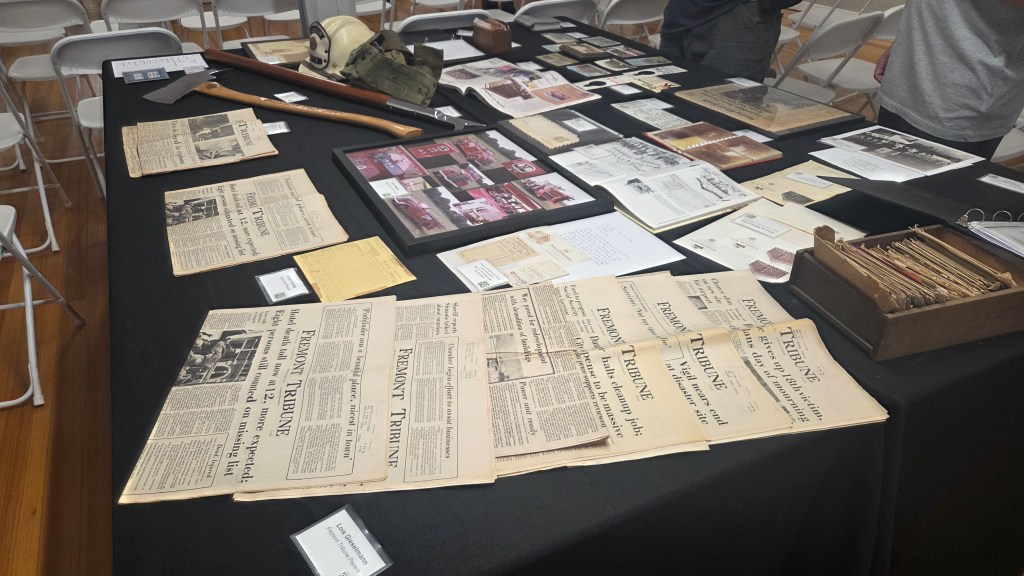
I came back to visit John C. Fremont Days on July 10, 2026, exactly fifty years and six months after the Pathfinder explosion on January 10, 1976. The festival program framed the weekend around four anniversaries “250 years of the United States, 170 years of Fremont, 50 years since the Pathfinder Hotel explosion, and 25 years since September 11.” It gave the visit an unexpected weight. The exhibit was part of the Pathfinder Committee’s effort to preserve both the life of the hotel and the memory of the people affected by its destruction. It was not a private archive, a closed research room, or a collection available only by appointment. It was a public exhibit created for the community, open to people who remembered the Pathfinder, people who knew the story through family accounts, and people who may have entered simply because the gallery was there.
Dad told me he had loaned some items to the exhibit and that I should go see the collection. The display brought photographs, newspaper clippings, documents, dishes, and other everyday objects together so the hotel and the surrounding downtown could be understood as parts of the same community story. Seen beside one another, those pieces restored something of the Pathfinder’s daily life rather than presenting it only through the explosion that destroyed it. His recommendation brought me through the door, but everything my parents had taught me determined how I looked once I was inside.

Brown Drug bottles and tablets displayed in A Minute After Normal at Gallery 92 West, Fremont, Nebraska, 2026.
Among the photographs, headlines, dishware, and more immediately recognizable artifacts sat the small wooden recipe box. It was slightly damaged and easy to overlook. That was precisely why it held my attention. The recipe cards were quieter. They carried handwriting, abbreviations, corrections, names, ingredients, and assumptions from kitchens where no one expected a stranger to read them decades later. To another visitor, they may have looked like a modest collection of old recipes.
When I later processed the photographs, the cards justified that instinct. They ranged from muffins, cookies, brownies, caramel cake, fudge, macaroons, and biscuits to cheese sauce, casseroles, cheese strata, ham loaf, and scalloped oysters. Their different handwriting styles suggested several voices. Names such as Carrie H. Nye, Charlie Phillips, Pat Wire, and Laura Mettie remained attached to particular dishes. A card dated 1964 preserved a particular moment. Directions such as “hot oven” and “mix good and bake quick” revealed the confidence of cooks who knew more than they needed to record. The ingredients moved between older methods and midcentury convenience: lard and molasses beside canned soup, frozen vegetables, cornflakes, coconut, chocolate, cheese, ham, and oysters. The box opened toward family kitchens, church suppers, holiday baking, club luncheons, hotel dining, and the practical culture of feeding people in and around Fremont. It did not need a dramatic explanation to matter. Its ordinary life was its power.
The box I found at that festival became a doorway into a larger story about Fremont, the Hotel Pathfinder, and the community that gathered around its tables.
The exhibit was inside Gallery 92 West, home of the Fremont Area Art Association. There was a photography contest in another room of the gallery, and the main room featured local artists. The association was an all-volunteer organization, and it had lent the exhibition room to the Pathfinder committee for the fiftieth-anniversary display. Admission was free, the gallery was open only during limited daytime hours, and when I visited there was no docent, curator, or volunteer stationed inside the exhibit room. It was not a professionally curated museum installation, and it did not pretend to be. It was a community room temporarily given over to local memory.

The room housing A Minute After Normal at Gallery 92 West, Fremont, Nebraska, 2026.
The display had the feeling of a historical potluck. Families, former responders, local collectors, and other residents contributed what they had, while the gallery and committee asked residents to loan specific objects from private collections. Photographs, newspapers, hotel pieces, business artifacts, and personal accounts that normally lived in separate homes and storerooms were brought together for anyone to see. That informality made the exhibit feel generous, but also fragile and temporary. At the end of the month, the borrowed objects would return to their owners, and the room would become an art gallery again. That uncertainty was one reason I felt compelled to photograph the recipe cards while the box was still in front of me.
The exhibit brought together photographs, newspapers, dishes, bottles, hotel objects, and other pieces of Fremont history that had survived in private collections. Each object represented only part of the story, but together they gave visitors a way to imagine the building, the businesses around it, and the day that changed downtown.

Hotel Pathfinder room keys displayed in A Minute After Normal at Gallery 92 West, Fremont, Nebraska, 2026.
Some pieces related directly to the hotel. Others helped reconstruct the surrounding downtown world in which the hotel had existed. A room key points toward the daily operation of the hotel. Dishware suggests meals, banquets, and service. Pharmacy bottles bring nearby businesses into the picture. Newspapers preserve the words and images through which people first understood what had happened. A damaged bread box from Vienna Bakery that Dad loaned carries the physical evidence of damage in a way that a photograph cannot.

Vienna Bakery, Sixth Street, Fremont, Nebraska, 1890.
Vienna Bakery stood directly across the street from the Hotel Pathfinder. When the hotel exploded, a six-by-six-foot section of concrete sidewalk was hurled across the street and through the bakery’s roof. The damage closed the original location, but Vienna Bakery reopened on Main Street in downtown Fremont and remained there until the business closed in the 2000s.

Page 7 of the National Transportation Safety Board’s report maps the Pathfinder accident site, 1976.
I knew Vienna Bakery from that later chapter of its life. When I was in high school, I stopped there nearly every morning on my way to Bergan High School to buy doughnuts. I never knew that the battered bread box from the original bakery had survived the explosion, moved with the business, and was sitting somewhere in the back, only feet away from me during all those mornings.
When Vienna Bakery eventually closed, my father went into the Main Street location as a collector. He found the old bread box and asked about it. The people there told him that it had come from the bakery’s original location across from the Pathfinder and had simply remained there ever since. He purchased it.
Years later, he loaned the box to A Minute After Normal. One of the mounted newspaper articles beside it carried the headline “Vienna Bakery worker ducked flying metal.” The article and the battered box told the same minute from two directions: one recorded the person who survived, while the other was the object that endured. For me, the box carried one more layer of meaning.

A bread box from the Vienna Bakery displayed in A Minute After Normal at the Fremont Area Art Association, 2026.
Among the objects on display was a ship’s bell, recovered from the rubble during the cleanup after the explosion and later restored by the local Naval Reserve. A framed newspaper clipping beside it explained where it came from: the USS Fremont, a Navy vessel that had shared the town’s name and served through the Second World War. I had not expected the hotel’s wreckage to hand back a piece of naval history along with everything else. It sat there cleaned and mounted, its damage repaired well enough that a visitor could still ring it. The clipping, published in the Fremont Tribune on January 31, 1976, under the headline “Bell found, to be restored,” filled in the bell’s longer journey. The Navy had presented it to the City of Fremont in 1974. An admiral dedicated it to Mayor Arthur Peters and the Dodge County Historical Society, and it was placed inside the Pathfinder on a wooden frame. After the explosion, searchers recovered the bell from the rubble, tarnished and chipped; the wooden frame was gone.
The local Naval Reserve took responsibility for restoring it. In the newspaper photograph, Petty Officer First Class Thomas Bennett stood beside the damaged bell and explained that it had been soaked in acid overnight and still needed cleaning and polishing. He hoped the finished restoration would be marked by another dedication ceremony. Bennett called the bell “twice as historic.” It had already carried the history of the USS Fremont through the Second World War and later service in the Middle East. Now it had survived the destruction of the Pathfinder. The bell in front of me had passed from a warship to a civic ceremony, from a hotel into rubble, and from the rubble into restoration, and somehow remained a bell.

The USS Fremont ship’s bell displayed in A Minute After Normal, an exhibit at the Fremont Area Art Association, 2026.
One table held a firefighter’s own gear: a helmet marked CAPTAIN, a pike pole, and an axe stamped FREMONT FIRE DEPT—tools that had done real work on that morning fifty years earlier. The name on the card was Don Sawyer. It matched a name I already had from a separate account of that day—a 2011 newspaper retrospective that identified him as one of the first responders and credited him with pulling ten people from the wreckage at the building’s southeast corner. I stood between the tools he had used and the record of what he had done with them, all gathered in the same room.

Don Sawyer’s helmet, pike pole, and fire axe displayed in A Minute After Normal at Gallery 92 West, Fremont, Nebraska, 2026.
Inside the gallery, the artifacts were presented as parts of a larger public story. Photographs and newspapers gave visitors a broad view. Smaller objects required closer attention. Some pieces could be understood immediately because a hotel name, business name, or label told the viewer what they were. Others depended on context. A room key is recognizable. A plate bearing the hotel’s name announces its connection. A newspaper headline explains why it is present. A small wooden recipe box does none of those things by itself. That is why the box was easy to overlook. It sat on an open table among the exhibit materials, alongside a three-ring binder holding a typed personal account and two photo albums. All of it was set out for visitors to pick up, open, and page through, not displayed behind glass or roped off.
The photographs preserved more than the words on the cards. They preserved the experience of encountering the collection together: one or two cards drawing the eye from the table and others waiting inside the box, like a kitchen collection briefly opened to the whole town. An exhibit changes an object’s context. A recipe box that once belonged to ordinary use became, in the gallery, part of a historical presentation. Its placement beside Pathfinder artifacts encouraged visitors to think about the domestic life that existed around the hotel.
It offered fourteen handwritten recipes and the feeling of a kitchen collection gathered over time. The cards carried several handwriting styles. Some included names. One included a date. The instructions ranged from fairly complete to extremely abbreviated. The collection looked used rather than formally assembled for display. Those details made the box compelling. The public exhibit gave the box visibility.
Foundations of Fremont
Before the Hotel Pathfinder could stand, Fremont first had to become a city capable of supporting a hotel like it.
The building did not rise in isolation. It was the product of nearly sixty years of movement, settlement, agriculture, transportation, commerce, and civic ambition. By the time plans for the Pathfinder took shape, Fremont had become the working center of a much larger region. Its businesses served the people who lived within the city, the farming families who came in from the surrounding countryside, and the travelers who arrived by railroad and highway. The place mattered before the building did.
The story begins with the rivers.
Long before Fremont was surveyed or named, the Platte and Elkhorn river valleys were homelands, hunting grounds, and travel corridors for Native peoples. The land north of the Platte where Fremont would eventually be established lay within Pawnee country. The wider lower Platte region was also known and traveled by Otoe-Missouria, Omaha, and other Native nations whose knowledge of its rivers, seasons, trails, and resources long preceded the arrival of American town builders.
Fremont’s founding took place during a period of rapid dispossession. Treaties, federal policy, disease, military pressure, and incoming settlement were forcing Native communities from much of the territory that became Nebraska. The streets and property lines later drawn across Fremont were therefore not placed upon empty land. They were part of a much larger transformation of the river country.
The Platte itself encouraged movement. Wide, shallow, and braided across the plains, it became one of the principal natural corridors across the continent.
The Mormon Trail followed the north side of the Platte. Near the future Fremont townsite, travelers also had to negotiate the Elkhorn River, where a ferry helped carry people, wagons, animals, and supplies across the water. Long before Fremont had hotels, stores, or railroad depots, the surrounding country was already a place through which people passed on their way somewhere else.
Nebraska Territory was organized in 1854. Two years later, a group of seven pioneers gathered to establish a town near the Platte and Elkhorn rivers. Fremont was founded on August 23, 1856, and the Fremont Town Lot Company laid out the original townsite that year.
Because a federal land survey had not yet reached the area, the town’s planners used the Military Road as their baseline. That road, now represented by Military Avenue, connected Omaha with Fort Kearny and provided the young settlement with one of its earliest links to the outside world.
The founders were not simply responding to the settlement that already existed. They were anticipating what they believed would come next. They expected that a transcontinental railroad would eventually follow the Platte River valley, and they placed their town where they hoped it would benefit from that route.
John Charles Frémont had traveled through the Platte River country during his 1842 expedition to the Rocky Mountains. The government reports and maps produced from his journeys reached a large national audience and helped turn him into one of the most celebrated figures associated with western exploration. Although his parties frequently followed routes already known to Native peoples, traders, trappers, and earlier travelers, the published reports presented those routes to eastern readers in a form they could study and carry west.

John C. Frémont in military uniform, 1800s.
Detail from John C. Frémont’s 1842 expedition, showing the “Nebraska or Platte River” near the future Fremont area. Frémont’s journal describes encountering Buffalo in the Platte River Valley: “June 30th. First view of buffalo. The air was keen the next morning at sunrise, the thermometer standing at 44° and it was sufficiently cold to make overcoats very comfortable. A few miles brought us into the midst of the buffalo, swarming in immense numbers over the plains, where they had left scarcely a blade of grass standing. Mr. Preuss, who was sketching at a little distance in the rear, had at first noted them as large groves of timber. In the sight of such a mass of life, the traveler feels a strange emotion of grandeur. We had heard from a distance a dull and confused murmuring, and when we came in view of their dark masses, there was not one among us who did not feel his heart beat quicker. It was the early part of the day when the herds are feeding, and every where they were in motion. Here and there a huge old bull was rolling in the grass and clouds of dust rose in the air from various parts of the bands, each the scene of some obstinate fight. Indians and buffalo make the poetry and life of the prairie and our camp was full of their exhilaration.”

Map of John C. Frémont’s expeditions to the Rocky Mountains, Oregon and Northern California, 1844.
John C. Frémont’s expeditions were never entirely his story alone. Jessie Ann Benton Frémont, born in Virginia in 1824, had grown up inside the political world of Washington as the daughter of Missouri senator Thomas Hart Benton. Her father was one of the nation’s strongest advocates of western expansion, and Jessie was educated unusually well for a young woman of her time. She listened to political discussions, accompanied her father through the Capitol and White House, and learned early how public reputations and national ambitions were made.
Through her father’s circle, Jessie met the young Army officer John Charles Frémont. He was eleven years older than she was, and her family initially opposed the match. Nevertheless, the couple married secretly in October 1841, when Jessie was seventeen. Thomas Hart Benton eventually accepted the marriage and became an important supporter of his son-in-law’s expeditions and political career.
While John traveled west, Jessie helped shape what the public learned from those journeys. When he returned with field notes, measurements, maps, and memories, she assisted in organizing and editing the reports that turned technical exploration into readable narrative. Those accounts allowed eastern readers to imagine the Platte Valley, the Rocky Mountains, and the routes toward Oregon and California. Frémont supplied the expedition, but Jessie helped give it a voice. His reputation as “the Pathfinder” was built not only on where he traveled, but also on how effectively those travels were presented to the country.
Their partnership continued when exploration gave way to politics. Jessie advised her husband, maintained correspondence, received supporters, and became a visible figure during his 1856 presidential campaign. Supporters wore ribbons proclaiming “Frémont and Our Jessie,” and campaign songs treated her as part of the national cause. At a time when women could not vote, she had become an active participant in a presidential campaign. John carried the title of Pathfinder, but Jessie Benton Frémont helped create the public identity that made the title endure.

Jessie Benton Frémont, 1800s.
In 1856—the same year the Nebraska town was founded—Frémont became the first presidential nominee of the newly organized Republican Party. The founders gave their town his name. More than half a century later, when Fremont needed a new hotel, the building would receive his famous nickname.

A campaign print depicts John C. Frémont on horseback as the Republican candidate for president, 1856.
Frémont’s political path repeatedly crossed Abraham Lincoln’s. At the first Republican National Convention in 1856, Frémont won the presidential nomination. William L. Dayton became the vice-presidential nominee, but on an informal ballot Lincoln finished second, placing the relatively unknown Illinois politician briefly beneath Frémont in the party’s first national campaign.

An 1856 Frémont and Dayton campaign ribbon bearing the slogans “Free Soil, Free Speech, Free Press” and “Frémont,” 1856.
Five years later, their positions had reversed. During the Civil War, President Lincoln appointed Frémont a major general and commander of the Department of the West. On August 30, 1861, Frémont placed Missouri under martial law and declared that enslaved people claimed by those taking up arms against the United States would be freed. Lincoln, concerned about both constitutional authority and the loyalty of the border states, directed him to bring the order into conformity with the federal Confiscation Act. Lincoln removed him from command later that autumn amid the emancipation dispute as well as broader complaints about administration, procurement, and military performance.
Their names crossed once more in 1864, when the Radical Democracy convention nominated Frémont to challenge Lincoln for the presidency. He remained a candidate for several months before withdrawing on September 21, concluding that continuing his campaign could divide the anti-Democratic vote and help elect George B. McClellan.
Frémont had once stood above Lincoln in the Republican Party’s first presidential campaign, but history gradually placed him in Lincoln’s shadow. In the Nebraska town bearing Frémont’s name, the relationship became part of the landscape: the Lincoln Highway crossed Fremont, and inside John C. Fremont City Park, a statue of Abraham Lincoln still stands, casting his shadow across the Pathfinder’s ground.

A statue dedicated to Abraham Lincoln was erected in 1921 in John C. Fremont City Park, 2026.
Early Fremont consisted of only a small collection of log and frame buildings. New townsites were being promoted throughout Nebraska Territory, each competing for settlers, investment, government business, transportation routes, and commercial importance. Some towns grew. Others disappeared. A name on a plat did not ensure that a community would survive.
Fremont’s organizers offered inducements, including lots and shares in the town company, to attract residents and businesses. Commercial activity began to concentrate south of Military Road, particularly along Sixth Street between Broad and Main.
The town received one of its first important bursts of business in 1858, when reports of gold in Colorado sent fortune seekers west. Travelers moving through the Platte Valley needed food, animals, wagon repairs, equipment, lodging, and other supplies. Fremont’s merchants discovered that a town could prosper not only from the people who settled there but also from the people passing through it.
That lesson would remain important throughout the city’s history.
The great wager made by Fremont’s founders began to pay off at the end of 1865, when Union Pacific tracks reached the town. For a time, Fremont stood at the western edge of the completed railroad. People and freight traveling beyond the railhead had to transfer to wagons or other forms of transportation.
The railroad did more than shorten the journey to Omaha. It changed the scale on which Fremont could operate. Agricultural products could move outward more efficiently, while machinery, lumber, household goods, newspapers, mail, and travelers could arrive in greater volume.
The town was no longer simply beside a trail. It was becoming part of a national transportation system.
The Fremont Tribune began publishing on July 24, 1868, giving the young community a permanent newspaper through which residents could follow local business, politics, court proceedings, social events, railroad developments, and the arguments of their neighbors.
Another major stage of railroad development followed in 1869. The Sioux City and Pacific Railroad reached Fremont, connecting it more directly with communities to the north. That same year, work began on the Fremont, Elkhorn and Missouri Valley Railroad, which built northwest from the city through the Elkhorn Valley.

John C. and Jessie Benton Frémont, 1880s.
These lines made Fremont a junction.
The Platte Valley provided one east-west corridor. The Elkhorn Valley opened another route into the agricultural interior of northeastern Nebraska. Fremont stood where those systems met, gathering the products of the surrounding countryside and distributing manufactured goods and services back into it.

Fremont, Elkhorn and Missouri Valley Railroad locomotive No. 209 pulls a passenger car above Nevada Gulch on the Portland Line, 1900.
The farms around Fremont were not separate from the city’s history. They were one of the principal reasons the city grew.
Dodge County and the surrounding region produced grain, livestock, dairy products, and other agricultural goods. Rural families came into Fremont to sell what they raised and to purchase what they could not produce at home. They visited implement dealers, banks, lawyers, doctors, clothing stores, furniture stores, pharmacies, grocers, newspapers, and county offices.
They also came for reasons that could not be measured entirely in sales. They attended church gatherings, school functions, political meetings, fairs, theatrical performances, weddings, dinners, and celebrations. They visited friends and relatives, heard the latest news, and participated in the social life of the county.
Fremont became the working center of a community that extended far beyond its city limits. North Bend, Hooper, Scribner, Nickerson, and the farms and smaller settlements between them were connected to Fremont through commerce, transportation, government, and family ties. Roads and railroads moved people in both directions.
As trade increased, the appearance of downtown began to change. The earliest commercial buildings were modest frame structures. They were practical and relatively inexpensive, but they also reflected the uncertainty of a town whose permanence had not yet been established. As Fremont became more prosperous, wooden buildings increasingly gave way to brick and masonry. Stores grew larger. Banks, offices, warehouses, newspapers, hotels, and public buildings gave the downtown district a more substantial appearance.
One of those early signs of confidence appeared at the southeast corner of Sixth and Broad Streets. In 1871, the three-story Occidental Hotel was built there at a reported cost of twenty thousand dollars. Its location placed it near Fremont’s developing commercial center and the transportation traffic moving through town. In 1881, E. L. Eno purchased the property and renamed it the Eno Hotel.

The Eno Hotel at the southeast corner of Sixth and Broad Streets, Fremont, Nebraska, 1880s.
For several decades, the Eno served the needs of the city in which it had been built. But Fremont continued to grow around it. The 1880s were especially important. Agricultural processing, milling, meatpacking, and the manufacture and sale of farm implements expanded.
The railroad junction also made Fremont an important transfer point. Passengers changed trains. Baggage and freight were redirected. Traveling salesmen stopped to meet clients or continue into the surrounding region. Each arrival created a need for meals, rooms, transportation, and places to conduct business. Downtown developed alongside that traffic.
The building now known as the Love-Larson Opera House was completed in 1888, demonstrating that Fremont possessed both the population and the cultural ambition to support a substantial performance hall. Banks and commercial blocks expressed confidence in continued business. Churches, schools, clubs, and civic organizations demonstrated that families no longer regarded Fremont as a temporary frontier settlement.

Love-Larson Opera House, Broad Street, Fremont, Nebraska, 1880s.
Downtown also became the city’s shared public space. Stores, restaurants, hotel lobbies, lodge rooms, churches, theaters, and meeting halls gave people reasons to gather beyond the immediate exchange of money. Banquets, lectures, conventions, political meetings, weddings, and traveling entertainments all required rooms large enough to receive a crowd.
By the end of the nineteenth century, Fremont was no longer waiting for its future. It had become a recognized regional commercial center.

An 1893 U.S. Geological Survey map showing the early layout of Fremont and the surrounding Platte and Elkhorn river country.
The economic depression of the 1890s slowed development, but Fremont’s banks survived, and the city continued to benefit from its agricultural and transportation base. Livestock operations expanded, including the practice of feeding animals in transit before they continued to larger markets. By the turn of the twentieth century, the city supported dozens of manufacturing establishments in addition to its retail, wholesale, railroad, and professional businesses.
A fourth railroad connection arrived in 1906, when the Chicago, Burlington and Quincy reached Fremont. The city was now linked by rail in several directions. Freight, passengers, mail, salesmen, farmers, merchants, and visitors moved continually through the community.
At the same time, a new form of transportation was beginning to reshape local expectations. Automobiles brought more travelers onto the roads and gave rural families greater freedom to reach Fremont on their own schedules. In 1913, the Lincoln Highway was designated through the city as part of the first coast-to-coast automobile route in the United States. The railroad remained essential, but Fremont was no longer dependent upon rail travel alone.

A downtown drugstore in Fremont, Nebraska, 1913.
Its location continued to work in its favor. The narrow stretch of usable land between the Platte and Elkhorn rivers naturally directed roads and railroad lines through the area. Fremont stood close enough to Omaha to remain connected to a larger market, but far enough away to function as a commercial center in its own right.
That position created opportunities, but it also created expectations.
By the middle of the 1910s, Fremont had outgrown the hotel that stood at Sixth and Broad.

Pedestrians, storefronts, automobiles, and a streetcar in downtown Fremont, Nebraska, 1913.
The Eno Hotel had been constructed for a much smaller community. Since then, Fremont had become a railroad junction, a county seat, an agricultural trading center, a wholesale and manufacturing city, and an important stop on a transcontinental automobile route.
The city wanted a hotel that matched the image it had developed of itself. Plans for a larger building moved forward in 1916. The old Eno Hotel would give way to a six-story structure containing more than one hundred guest rooms, along with dining, business, meeting, and social spaces. The new hotel would be called the Pathfinder, borrowing the famous nickname of the explorer for whom Fremont itself had been named.
The Pathfinder was therefore not an isolated monument placed unexpectedly at a downtown corner. It was the architectural result of everything Fremont had spent six decades becoming.
Fremont was ready for the Hotel Pathfinder.
Hotel Pathfinder
In my memory of that gallery table, the recipe box looked domestic and almost anonymous. The photographs and hotel pieces around it pointed toward a much larger public world: the six-story Pathfinder in its working years.
The Hotel Pathfinder opened in 1917 at the southeast corner of Sixth and Broad Streets. The new hotel rose six stories above downtown. It had 115 rooms, the largest hotel in Fremont’s history. Even today, the largest hotel, Baymont, has only 100 rooms.
These rooms were joined by a coffee shop, dining room, cocktail lounge, ballroom, and meeting rooms, making it much more than a place to sleep. The building also housed Brown Drug Store and the Louie Hruska Barber Shop, two named businesses that became part of the hotel’s daily life. Calling the hotel the Pathfinder gave it a sense of place before a guest ever crossed the lobby. The name was not borrowed from somewhere else. It belonged to Fremont.

An early photograph of the Hotel Pathfinder, 1918.
A building of that size was impossible to ignore. Photographs show it filling the corner and rising above many of the structures around it. The Pathfinder helped define the view along Broad Street. It became part of the skyline residents recognized and part of the directions they gave. For travelers arriving by train or automobile, it offered a first impression of the city. Families stayed while attending weddings, funerals, graduations, and reunions. Salesmen met clients. Visitors asked the desk clerk how to find a local office or shop. The hotel stood where private travel and public life crossed.

The Hotel Pathfinder, looking east along Sixth Street, Fremont, Nebraska, 1919.
From the front desk to the kitchen, the staff kept the Pathfinder running, much of their work unseen by the guests they served.

A postcard advertising the Hotel Pathfinder as “Nebraska’s Model Hotel” and “European Fireproof,” noting that the hotel sat “on the Lincoln Highway,” 1918.
A banquet could honor a retiring employee, welcome a visiting official, raise money, or mark an anniversary. A luncheon could be social and practical at the same time. A wedding reception could place the hotel permanently inside a family’s history. Someone could live in Fremont for years without ever renting a room and still have a Pathfinder story.
The dining rooms were central to that relationship. A hotel can rent rooms without becoming part of a town’s daily life; a restaurant changes that. Food opened the Pathfinder to people who had no reason to stay overnight. A farmer in town on business, a local couple meeting friends, a civic club gathering for lunch, or a family celebrating a wedding could all enter without carrying a suitcase. The restaurant and ballroom had been part of the hotel from the beginning, so meals, meetings, banquets, receptions, and celebrations were not secondary activities. They were part of the building’s purpose.
Coffee allowed the dining room to function between meals, giving guests and local residents a reason to sit, wait, read the paper, or continue a conversation.

An early postcard of the Hotel Pathfinder coffee shop, 1920s.
The Pathfinder kitchen was rooted in Fremont’s regional food economy while also reaching far beyond it. Hotels bought from suppliers, wholesalers, grocers, dairies, meat markets, and commercial distributors rather than receiving every ingredient directly from a nearby farm. Even so, Nebraska beef, pork, poultry, dairy products, grain, and seasonal produce formed part of the food world surrounding the hotel. Railroads and highways brought coffee, chocolate, coconut, oysters, spices, canned goods, and other ingredients from much farther away. A Pathfinder table could therefore feel local without being limited to local ingredients.
The recipe box reflects that same combination. Its cards contain ham loaf, casseroles, biscuits, cookies, and fudge, but also coconut, chocolate, pimentos, Swiss cheese, Parmesan, and oysters. The collection reflects a Nebraska food culture connected to a national market. Hotel kitchens and home kitchens operated at different scales, but they did not exist in separate culinary worlds. Guests expected recognizable food, and banquet dishes often needed to feel familiar enough for a broad group while still carrying a sense of occasion.
Recipes moved too. A cook might learn a preparation at work and make a smaller version at home. A hotel employee might bring a family recipe into the kitchen. A guest might ask how a dish had been prepared. A recipe could be copied from a newspaper, a package, a church cookbook, a restaurant kitchen, or a friend, then altered until its origin became difficult to trace. That circulation is part of what makes the fourteen cards so evocative. A handwritten recipe can carry the food world of a hotel, a household, a church supper, and a community gathering at the same time. Public dining rooms and private kitchens were connected by the people who moved between them.
The recipe cards should not be identified as recipes from the Hotel Pathfinder kitchen simply because they appeared in a Pathfinder exhibit or because that would create a tidier story. It does not provide a complete run of menus or a verified record proving that these fourteen dishes were served there. Their connection is broader and, in some ways, more revealing. They belong to the same regional culture of cooking, hospitality, celebration, and exchange that filled the hotel’s tables. Scalloped oysters, caramel cake, cheese sauce, and ham loaf make sense in the world around the Pathfinder whether they first appeared in its kitchen, in an employee’s home, at a church supper, or at a family gathering.

An early postcard of the Hotel Pathfinder lobby, 1920s.
Weddings and family celebrations placed a different kind of meaning inside the same rooms. The ballroom and banquet spaces allowed families to host more people than a home could hold while providing tables, service, food, cleanup, and a setting that made the day feel formal. The Pathfinder entered family records through photographs, invitations, announcements, and stories repeated for years.

A postcard featuring the Hotel Pathfinder, 1930s.
On February 23, 1954, at approximately 6:20 p.m., natural gas ignited in the basement of the Hotel Pathfinder. Investigators determined that gas had escaped from a defective main outside the building, seeped through the hotel’s west wall, and accumulated in the lower portion of the structure before encountering an ignition source that was never identified.
The explosion damaged the basement and the enclosed space beneath the sidewalk along the west side of the building. Concrete near the entrance was broken, windows were shattered, basement partitions were destroyed, and three concrete walls and several doors were damaged. Brown Drug, which occupied part of the first floor, also sustained losses. A drugstore window was broken, and materials stored in its basement storeroom were damaged.
The total loss was estimated at between $7,500 and $10,000, a substantial amount at the time. No one was killed. The Pathfinder survived. The damaged areas were repaired, and the building remained in operation.
Five years after the first explosion, the restored Pathfinder hosted a visitor moving toward national prominence. Massachusetts senator John F. Kennedy appeared at a breakfast inside the hotel while building support for the Democratic presidential nomination. He would win the presidency the following year.

A postcard of the Hotel Pathfinder featuring its “Banquet Facilities,” 1950s.
It was October 5, 1959, and Kennedy arrived a half-hour late. He spoke for less than ten minutes, without notes, setting aside the prepared text his staff had already handed to reporters. He had not yet formally announced his candidacy, but by then most people in the room assumed he would. Roughly two hundred people attended the breakfast, part of a single-day swing through Nebraska that would also take him to Columbus, Norfolk, and Hastings before nightfall. He identified agriculture and fiscal policy as the two issues he considered most important to the coming election and emphasized the importance of a strong America in the face of Communism. The Fremont Tribune later described him as personable, quiet, and polished. Jacqueline Kennedy had planned to make the trip as well but stayed home with a cold; his brother Ted had been delayed by snowstorms in Colorado and was set to rejoin the group the next day.
The visit left more behind in Fremont than a line in a hotel’s history. Jerry Foy, who would go on to chair the Dodge County Democratic Party for roughly two decades, later wrote that the encounter impressed him enough to file as a delegate to the 1960 Democratic National Convention in Los Angeles, where Kennedy won the nomination he had been quietly pursuing all along.
Decades later, Foy’s family still held on to the campaign buttons, delegate badge, and campaign hat from that year. They were the same kind of keepsakes that fill the drawers this story keeps returning to. Another Fremont family, the Lammes, received a Christmas card that year carrying a photograph of the Kennedys, a small trace of a relationship built during the same Nebraska campaign swing.
His appearance briefly connected the hotel to national political history, but the thousands of people who crossed its threshold without entering a history book are the real measure of its importance. The visiting politician, the traveling salesman, the bride and groom, the waitress refilling coffee, the housekeeper preparing a room, the local club beginning its luncheon, and the resident waiting for the elevator all occupied different versions of the same building.
A historical marker near the hotel’s original site lists some of its more notable guests: the actress ZaSu Pitts, race car driver Barney Oldfield, evangelist Billy Sunday, and the author Helen Keller. Whatever else the Pathfinder was to Fremont, it was also, for a night or a week at a time, a place where the wider world stopped in.

A postcard bills Fremont as “The Convention City,” showing the Hotel Pathfinder, one of its dining rooms, and a guest room, 1960.
By the 1970s, portions of the building were being used as apartments, and many residents were older adults. It remained a hotel, workplace, gathering place, and, for some, a permanent home. Boyd and Louise Hammond purchased it in March 1972 and became its final owners.

A postcard featuring the interior of the Hotel Pathfinder, 1970s.
On June 26, 1974, workers installed a new two-inch polyethylene gas main beneath the street north of the hotel. They inserted 348 feet of plastic pipe through approximately 337 feet of an older four-inch steel main, using the steel pipe as a casing. Approximately five and one-half feet of plastic extended beyond each end so the new line could be connected to the existing gas system. Seven smaller service lines along the route provided some incidental restraint, but the long plastic main itself remained free to move inside the casing.
The plastic line was not anchored to the ends of the steel casing, and the space around the plastic where it entered the casing was not sealed. It was joined to the surrounding system with compression couplings. Standard compression couplings were designed primarily to create a gas-tight seal; without additional locking or anchoring features, they were not intended to provide a specified amount of lengthwise structural restraint. The western connection, nearest the Pathfinder, used a smooth metal stiffener inside the plastic pipe and a coupling made by a different manufacturer. The combination had not been proven to produce a joint as strong as the pipe itself.
The pipe end had been cut at an angle with a hacksaw instead of squarely, leaving the top approximately one-quarter inch shorter than the bottom. It entered the coupling at approximately five degrees, slightly beyond the gas company’s own standard. The pipe manufacturer recommended a positive transition fitting for inserted runs longer than one hundred feet, and the coupling manufacturer offered a serrated locking stiffener intended to resist pullout. Neither was used. None of this was visible from the street.

Page 13 of the National Transportation Safety Board’s report reconstructs the failed compression coupling outside the Hotel Pathfinder. The upper diagram shows the pipe’s five-degree misalignment and its movement during two winters, ending in a total withdrawal of 2⅜ inches. The lower graph records the declining resistance of the recovered coupling during laboratory testing. The report was adopted July 7, 1976.
The new pipe lay inside its steel sleeve beneath Sixth Street, carrying natural gas through downtown Fremont. The polyethylene itself was not defective. It behaved as plastic pipe was expected to behave: it expanded when warm and contracted when cold.
The danger came from the length of the line, the freedom it had to move inside the steel casing, and the connection expected to hold it at the ends.
The pipe had been installed during warm summer weather. Temperatures exceeded one hundred degrees on three days during the work. On the day the connections were completed, the air temperature ranged from approximately sixty to eighty-six degrees, while the soil around the pipe was probably between sixty and sixty-six degrees.
Then came the first winter.
For approximately the first six months after installation, the line appears to have remained near its original position. During the winter of 1974–75, snow insulated the buried pipe from the coldest air temperatures. Even so, cooling produced an estimated three hundred pounds of pulling force on the western connection. The pipe began to withdraw from the coupling but did not come completely free. Approximately three-eighths of an inch remained inside the gasket.
When the weather warmed again, the plastic became more flexible and expanded. But the withdrawn end did not slide completely back into its original position. The line entered its second winter already partly pulled from the connection.
The winter of 1975–76 brought bitter cold and less insulating snow. The cold penetrated more deeply into the earth. The Safety Board calculated that the second winter produced between approximately five hundred and 623 pounds of contraction force. Beneath Sixth Street, the long plastic line pulled against the weakened grip that remained inside the coupling.
By January 1976, the western connection had already been weakened by the first winter’s movement. Above it, Fremont went on with its ordinary life.
On Friday, January 9, 1976, two Nebraska Natural Gas Company employees conducted a routine leak survey through downtown Fremont.
They checked the gas main in front of the Pathfinder. They tested the hotel’s basement foundation wall. They also checked the Vienna Bakery across Broad Street. Their instruments detected nothing.
The National Transportation Safety Board later emphasized that the company had been conscientiously conducting leak surveys. The negative reading did not mean the survey had been careless or that employees had ignored a detectable leak. The Sixth Street connection may still have been holding when the survey occurred. An instrument could detect gas already escaping; it could not warn that a connection was approaching mechanical failure.
At approximately six o’clock that evening, a gas-company emergency crew responded to a different leak at Fifth and D Streets, about three blocks east of the Pathfinder.
There they found another two-inch plastic gas main that had pulled out of a compression coupling. The crew repaired the leak at Fifth and D. The sequence is difficult to ignore.
On the evening before the Pathfinder exploded, gas-company employees repaired another two-inch plastic main that had pulled out of a compression coupling three blocks away. That night, the temperature continued to fall.
Imagine the Hotel Pathfinder on an ordinary Friday night in the mid-1970s. The lobby was active, the desk staffed, luggage arriving, telephones ringing, and guests unfolding newspapers in the lobby chairs. Upstairs, travelers were looking out across downtown from their beds. Somewhere in the building, KHUB’s voices were carrying Fremont over the air. In the dining room, business was discussed and neighbors lingered. In the kitchen, cooks and servers were closing for the night. In the ballroom, tables were cleaned after a banquet, a wedding, a club meeting, or a celebration important enough to deserve a room with ceremony around it.
Beneath Sixth Street, a plastic pipe contracted.
January 10, 1976
According to the story my mother told me while I was growing up, she was fifteen years old and stayed on the telephone with eight other girls until nearly five in the morning on January 10, 1976. The girls belonged to two groups of friends who had planned to meet at nine o’clock later that same morning in the Pathfinder’s coffee shop, near Brown Drug. A surviving first-floor plan places the coffee shop and dining room in the same commercial area as the pharmacy, confirming the setting she remembered.
I do not know which table they intended to use or how long they expected to stay. I know only the time, the place, and that all nine girls overslept.
By the time I studied the explosion photographs in the fiftieth-anniversary exhibit, those thirty-two minutes between nine o’clock and 9:32 had acquired a weight I had not understood as a child.
The small recipe box on the gallery table carried the ordinary life that made the disaster matter. The Pathfinder had been a place where people ate breakfast, worked a shift, kept an apartment, bought medicine, met friends, and expected the day to continue. The explosion did not interrupt an abstract landmark. It interrupted people in the middle of an ordinary Saturday morning.
The first known warning came at approximately 4:50 a.m. on Saturday, January 10, 1976. A man entering the Pathfinder through the west vestibule smelled natural gas and reported it to the night desk clerk. The clerk checked the second and third floors but did not detect the odor there. The west vestibule and basement were not checked at that time, and the source remained unresolved.

A staircase leads to upper floors in Hotel Pathfinder, Fremont, Nebraska, 1970s.
That fact should not be used to turn the night clerk into the person responsible for everything that followed. It demonstrates how difficult the danger was to understand. The odor had been reported near an entrance, but the search moved toward the familiar interior spaces of the hotel. There was no leaking appliance or open valve waiting upstairs to be found. The gas was entering from somewhere less obvious.
By then, the western end of the plastic main beneath Sixth Street had pulled completely free from its coupling. Natural gas was escaping into the surrounding soil. The frozen earth and concrete pavement above the line prevented the gas from rising freely into the open air. Instead, it spread laterally through the ground.
The Pathfinder’s basement extended beneath the vaulted sidewalks along its north and west sides. The walls beneath those sidewalks were made from brick and clay tile rather than solid concrete. Gas moving through the soil could pass through those permeable materials and enter the underground vault beneath the hotel. From there, it moved into the building.
When the day desk clerk arrived at approximately 6:35, she also smelled gas. The kitchen appliances were checked, but nothing there explained the odor. The appliances appeared normal because the leak was not coming from the hotel’s kitchen equipment.
The clerk attempted to contact Nebraska Natural Gas Company. It was Saturday, and the regular office was closed. Callers reached a recorded message that provided the home telephone numbers of three employees assigned to weekend service.
The message also mentioned a ten-dollar charge for after-hours repairs to customer-owned piping. It did not say that people would be charged merely for reporting a possible emergency. The fee applied to repairs made on private property. Nevertheless, a caller reporting the smell of gas heard information about a possible charge while trying to obtain help.
The company did not have a central weekend dispatcher receiving every report, comparing information, assigning priorities, and tracking employees in the field. Callers had to work through private home telephone numbers and try to reach whichever employee happened to be available.
Meanwhile, gas continued entering the Pathfinder. At 8:02 a.m., an employee of Vienna Bakery called the gas company to report a strong odor believed to be coming from the alley. Vienna Bakery stood across Broad Street from the Pathfinder and had already become part of the hotel’s life and of this story. Its call showed that the problem was not confined to one appliance, one room, or even one building.
Gas was present somewhere in the block. A serviceman reached the area at approximately 8:10 and confirmed the odor. He did not have a gas detector in his vehicle. The weekend service vehicles carried soap solution that could be applied to exposed fittings. Bubbles would reveal gas escaping from a visible connection. But soap could not locate a leak beneath frozen ground or trace gas moving through soil and foundation walls.
The serviceman drove to the company warehouse to obtain a flame-ionization detector. He had difficulty locating the instrument. When he found it, it did not work. He did not have the replacement parts needed to repair it. He returned to the area without the equipment necessary to trace the underground gas.
He also did not have a complete map showing the company’s gas facilities around the bakery. Because the bakery employee believed the odor was coming from the alley, the serviceman investigated there without knowing that the company had no gas facilities in that alley.
While he searched, the odor inside the Pathfinder intensified. At approximately 8:12, the day clerk again called the gas company after gas was noticed in the hotel lobby.
One of the weekend employees was already responding to the bakery report. A second said that he would come after completing another customer call he had received earlier. The third could not be reached at home. A supervisor was notified.
The reports from the hotel and the bakery were part of the same emergency, but no central dispatcher was assembling them into one picture. No one was tracking the growing sequence: A smell at the hotel entrance before dawn. An odor when the day clerk arrived. Gas in the lobby. A strong smell across the street.
The pieces existed, but the response remained fragmented among home telephone calls and employees moving independently through the city. The three people assigned to weekend calls were an appliance installer, a truck foreman, and an employee responsible for maintaining trucks and other equipment. They had practical experience with ordinary service work, but they had not received formal emergency training in classifying gas leaks, coordinating evacuations, or using the specialized instruments needed to locate gas underground.
At approximately 8:25, the hotel maintenance man entered the basement. He checked the boilers and the three gas meters. None appeared to be leaking. He then entered the vaulted space beneath the sidewalk at the hotel’s northwest corner. There, the odor was much stronger.

Lower level of Hotel Pathfinder, January 1976.
The maintenance man ran out of the basement and told the desk clerk to call the gas company again. He also called the police emergency number. The police supplied the same gas-company telephone number that the hotel had already been calling. They did not provide a separate emergency contact or initiate a coordinated response involving the police, fire department, and utility.
The maintenance man eventually located the home telephone number of the gas company’s district manager and reached him directly. The federal investigators later wrote that it was “only by chance” that hotel employees managed to reach the person they needed. The minutes continued to pass.
Inside the Pathfinder, people went on with their morning. Permanent residents remained in their rooms and apartments. Employees were working. Customers and visitors moved through the first-floor businesses and public spaces. Some may have noticed the odor. Others may not have smelled anything at all.
Natural gas does not necessarily spread evenly through a building. Concentrations can be severe in one area while people elsewhere remain unaware of the danger. The gas had entered through the lower northwest section, beneath the sidewalk and close to the part of the hotel that would suffer the greatest destruction.
By approximately 9:10 a.m., three gas-company supervisors and a serviceman were at the Pathfinder. A combustible-gas indicator was finally available. The probe was inserted through an opening in the north foundation wall beneath the sidewalk vault. The instrument registered what the federal accident report described as 100 percent gas.
The reading confirmed that the odor was not a minor appliance leak or a faint trace carried on the air. A severe concentration had accumulated beneath and inside the hotel. The gas-company employees told the maintenance man that the Pathfinder had to be evacuated immediately. Twenty-two minutes remained.
The surviving records do not provide a complete room-by-room account of what happened after the order was given. They do not establish precisely who was warned, how the warning moved through the building, which floors or rooms were reached, or why every occupant was not removed. We should not invent that missing sequence. Nor should the failure to evacuate be reduced to an accusation against one clerk, maintenance worker, serviceman, or supervisor. Too much time had already been consumed before the instrument was placed against the hotel foundation.
The Pathfinder did not explode without warning. The warnings accumulated for nearly five hours. At 9:31 a.m., the Pathfinder still existed as a hotel. One minute later, it existed as a disaster scene. At 9:32 a.m., the accumulated natural gas ignited.
The precise source of ignition was never identified. No particular pilot light, electrical spark, cigarette, switch, appliance, or piece of equipment could be established as the source. Something provided the spark. No one would ever be able to say exactly what it was.
The explosion tore through the northwestern portion of the Pathfinder. It gutted the hotel’s northwest corner and destroyed much of the first floor. Sections of the first and second floors collapsed into the basement, carrying people into broken masonry, debris, gas, and fire.

View of damage inside the Hotel Pathfinder. A clock stopped shortly after 9:32 a.m., January 10, 1976.
The blast lifted the concrete sidewalk above the hotel’s underground vault and turned entire sections into projectiles. One square of concrete measuring approximately six feet by six feet was hurled across Broad Street and through the roof and second floor of Vienna Bakery.
Other concrete sections destroyed two automobiles and damaged several more. Windows shattered within a one-block radius. Across a wider portion of downtown, glass broke and automobiles were struck by flying debris. Brick, concrete, metal, furniture, prescriptions, paper, glass, and pieces of the hotel rose into the air and fell across Sixth and Broad. Seven surrounding structures were damaged.
One civilian eyewitness, writing soon afterward, remembered white papers high above the building “like a sky full of doves.” He later learned that some of them were prescriptions from Brown Drug.
Across Broad Street, Vienna Bakery was struck almost immediately. Employee Rollin McDuffer was working near the rear of the bakery when the explosion drove metal and debris through the building. He remembered ducking as a piece of sheet metal—apparently a cover from the bakery’s ductwork—came toward him. His next clear memory was finding himself outside the rear door.
After regaining his bearings, McDuffer moved toward the front of the bakery. From there, he could see fire at the entrance of the Pathfinder and debris still falling from the building.
“The whole doorway was just a big ball of fire,” he remembered. Two bakery clerks had been working nearer the front, where the blast shattered glass and sent concrete, metal, and fragments of the Pathfinder across the street and into the business. The six-foot section of sidewalk had crossed Broad Street and crashed through the structure above them.

A fire engine stands in front of Vienna Bakery and the Love-Larson Opera House, across Broad Street from the Hotel Pathfinder, January 10, 1976.
McDuffer escaped without injury, but the force of the explosion followed him beyond the bakery. His automobile was parked near the First National Bank building on Broad Street. Flying debris punctured the car, and a parking meter was driven through its windshield. The damage to Vienna Bakery demonstrated how far the blast extended beyond the Pathfinder itself.
People across Sixth Street were not merely witnesses to the destruction. They were standing inside its path.
Hotel owners Boyd and Louise Hammond were not at the Pathfinder that morning. Boyd’s grandfather Frank Hammond had published the Fremont Tribune for 59 years.
They were preparing to attend the funeral of their twenty-four-year-old daughter, Ann Hammond Hoppes, who had been murdered in Lincoln by her husband, Tom Hoppes.

Firefighters work at street level on Hotel Pathfinder, January 1976.
Instead, they received a telephone call from Boney Schafersman. As Schafersman recalled it in a later Fremont Tribune retrospective, he told Boyd: “I hate to tell you this, but your hotel just blew up.” Within seconds, one family’s private grief and Fremont’s public disaster collided.
The explosion killed twenty people and injured thirty-nine. Three of the dead were the gas-company supervisors who had come to investigate the leak. Only minutes before, they had been standing near the hotel foundation with the instrument that confirmed the danger.
The blast was followed almost immediately by fire. Gas burned among the broken concrete near the northwest corner. Firefighters observed flames burning in the street approximately twelve feet from the hotel. Flames spread through exposed rooms and collapsed spaces.

Firefighters approach the burning Hotel Pathfinder amid debris after the explosion, January 10, 1976.
Smoke filled the surviving upper stories. Parts of the hotel remained standing, but floors, walls, stairways, windows, and rooms had been broken open or torn away. Residents appeared at windows and called for help.

Smoke rises from the Hotel Pathfinder, viewed from the Broad Street Viaduct looking north, January 10, 1976.
For a moment, people nearby could do little more than stare at the scale of what they were seeing. Then they began moving toward it. The first minutes did not divide neatly into official responders and bystanders.
Police officers, firefighters, ambulance crews, hotel employees, utility workers, and civilians entered the same chaotic scene. People who were close enough to help raised ladders, moved debris, carried survivors, directed traffic, and assisted arriving crews before a full command structure could be established.

Firefighters direct hoses into the burning lower floors of the Hotel Pathfinder as responders and civilians gather nearby, January 10, 1976.
A detailed typed eyewitness account preserved from the period records one civilian’s run toward Sixth and Broad. He described broken glass beneath his feet, concrete in the street, hanging wires, open holes leading into the basement, and screams coming from the dark interior. At the aerial ladder, he worked beside Fremont firefighters Bill Johnson and Don Wilkinson. Johnson entered smoke-filled upper rooms and passed residents through windows to people waiting on the ladder. The aerial moved from opening to opening as rescuers tried to reach people trapped above the fire.

Smoke pours from the damaged Hotel Pathfinder as ladders are raised along the building, January 10, 1976.
Some residents could climb. Others could not. Smoke burned the rescuers’ eyes. Clothing caught against the window frames. Survivors had to be lifted through openings and lowered one person at a time while flames continued below.
The eyewitness account captures details that no technical report could preserve. One rescued woman worried about losing a slipper while she was being carried down. In the middle of fire, smoke, broken walls, and fear, an ordinary concern remained: her shoe.
Another person at a window was an old friend and former teacher of the civilian rescuer. Recognizing her gave him enough strength to continue. He remembered Johnson disappearing repeatedly into the smoke and returning with another survivor. He remembered the rescuers directing attention toward those who were still alive and could still be reached.
The account is immediate and emotional, but not always certain about every identification. It should be read as the memory of someone working amid confusion rather than as an official roster. Its value is in what it preserves: the weight of people on the ladder, the smoke, the cold, the small human details, and the repeated decision to go back.

Smoke rises from Hotel Pathfinder, Fremont, Nebraska, January 1976.
Firefighter Don Sawyer was also among the first responders and was later credited with helping remove ten people from the hotel’s southeast corner. Firefighters used ground ladders, the aerial ladder, and elevated equipment positioned behind the building. Some survivors reached a lower roof and descended by ladder. Others were removed through windows. Mutual-aid departments from surrounding communities came to Fremont as the emergency expanded.
Winter made every part of the response harder. Water from the fire hoses froze on streets, ladders, equipment, clothing, and the building itself. Firefighters and civilians worked on ice among sharp glass and unstable masonry.
Smoke concealed holes and weakened floors. Walls that remained standing could still fall. The streets were on fire, gas was still burning, and no one at the scene could assume that the danger had ended with the first explosion.
The explosion did not end the gas emergency. Flames were visible among the broken concrete near the hotel, including fire in the street approximately twelve feet from the northwest corner. Gas continued to move beneath downtown Fremont.
Ambulances carried the injured away while family members began searching for people whose whereabouts were unknown. Police officers closed streets and tried to keep spectators beyond the reach of the fire, damaged buildings, falling debris, and emergency equipment.

Broad Street looking south, with the Love-Larson Opera House and Vienna Bakery pictured on the right. Fremont, Nebraska, January 1976.
Firefighters and rescuers continued working while the hotel burned. The company needed to isolate the damaged section of the distribution system, but the hotel block could not be shut down by turning one clearly identified valve.
Fremont’s gas-distribution network contained twenty district regulators and twenty-seven valves. The locations of those valves were not plotted on a complete system map that employees could immediately use at the scene.
Block-by-block facility cards existed, but they were stored at the company warehouse rather than carried in emergency vehicles. The system depended heavily on the personal knowledge of experienced employees.
Three supervisors who likely possessed some of the most detailed knowledge of the downtown network had been killed in the Pathfinder. The employees still working could not immediately determine which combination of valves would isolate only the hotel block.
At approximately 11:30 a.m., the company shut down four district regulator stations, cutting gas service to about half of Fremont. That broader shutdown was necessary because the immediate area could not be isolated with confidence.
The Fremont Fire Department and mutual-aid crews continued fighting the fire into the early afternoon. Water froze beneath them as they worked among unstable walls and open sections of the building.

Smoke envelops the Hotel Pathfinder as firefighting operations continue, January 10, 1976.
Police kept the surrounding streets closed. Ambulances continued moving the injured. Families gathered and waited for news. At approximately 2:30 p.m.—five hours after the explosion—utility crews physically cut and capped the four gas mains supplying the intersection of Sixth and Broad. The gas was not stopped simply by closing a nearby valve. The pipes had to be exposed, cut, and sealed.
The Nebraska National Guard arrived that afternoon and secured a four-block area around the Pathfinder. The perimeter protected the public from more than the ruined hotel. Fire, unstable walls, broken windows, damaged automobiles, hanging debris, open excavations, heavy equipment, and the underground gas emergency made the surrounding blocks dangerous.
Downtown Fremont had changed from an active rescue scene into a guarded disaster zone, but the danger beneath the streets remained. Approximately nine hundred people experienced an interruption of gas service that day.
Even after the mains at Sixth and Broad had been cut and capped, gas remained trapped beneath the frozen ground and concrete pavement. At ten o’clock that night, more than twelve hours after the Pathfinder exploded, testing beneath the intersection still showed a gas concentration between 60 and 70 percent.
The northwest corner of the Pathfinder was gone. Parts of the first and second floors had collapsed into the basement. The remaining walls were blackened, broken, and exposed to the winter air.
The Pathfinder had stood for nearly sixty years. It had survived changes in ownership, financial trouble, declining fortunes, repairs, alterations, conventions, businesses, travelers, permanent residents, celebrations, meals, and thousands of ordinary mornings.

Smoke rises from Hotel Pathfinder, Fremont, Nebraska, January 1976.
At 9:31 a.m., it had still contained rooms, apartments, businesses, medicine, coffee, furniture, clothing, conversations, work, and plans for the rest of the day. At 9:32 a.m., those ordinary things were thrown into the street and sky. Before that moment, the name Pathfinder meant a hotel at Sixth and Broad.
Afterward, it meant fire, collapse, twenty dead, thirty-nine injured, and a hole torn into the center of Fremont. On the night of January 10, there had not yet been time to investigate, explain, rebuild, or remember. There had only been time to respond, and beneath the frozen streets, the gas was still there.
By sunrise on January 11, 1976, Fremont had moved beyond the first day of the disaster, but it had not yet reached anything that could properly be called an aftermath. The city was still inside it.
The four-block area surrounding Sixth and Broad remained closed. The Nebraska National Guard held the perimeter. The damaged Pathfinder stood open to the winter air, its northwest corner gone and portions of its first and second floors collapsed into the basement. Fire, water, ice, broken masonry, twisted metal, hotel furnishings, business inventories, and the possessions of residents had been pressed into the same unstable ruin.
Most of the gas service interrupted the previous day was restored by early January 11, although the immediate disaster area remained isolated. Restoring service to much of the city did not mean the danger at the hotel had ended. Crews still worked around damaged utilities, unstable walls, frozen streets, open excavations, and gas that might remain trapped beneath pavement and soil.

Hotel Pathfinder from Sixth Street looking west, Fremont, Nebraska, January 1976.
Memorial Hospital of Dodge County had received injured people throughout Saturday. Doctors, nurses, aides, technicians, and other hospital staff treated burns, fractures, cuts, smoke inhalation, crushing injuries, and shock while attempting to identify patients and answer questions from families.
Preparation could not eliminate the uncertainty. Some patients arrived unable to identify themselves. Some hotel residents appeared on occupancy records without immediate confirmation of whether they had been inside. Family members came to the hospital before casualty lists were complete. A person reported missing might be in treatment, might have escaped without reporting to authorities, or might still be beneath the wreckage.
The first newspaper reports reflected that confusion. On January 10, the Fremont Tribune reported three deaths and as many as eighty injuries. A January 11 headline announced eleven dead and ten others missing. By January 12, newspaper reports placed the likely death toll near twenty. On January 13, another headline announced that a thirteenth body had been found and six people were presumed dead.
Those changing figures were not simply contradictions. They recorded stages of an unfinished search. Survivors were being located. Patients were being transferred. Names were being checked against hotel records. Search crews were reaching parts of the building that had been inaccessible the day before.
The final official count was twenty dead and thirty-nine injured. Eighteen people died in the immediate disaster. Two others died later from injuries sustained in the explosion.
For many survivors, the Pathfinder had not merely been a hotel. It had been home. Survivors emerged without identification, medication, money, clothing, furniture, photographs, family records, or keepsakes. Whatever remained inside could not be retrieved simply by walking back into a room. The building was unstable, guarded, and still being searched. Belongings that had survived the blast might still be buried, burned, soaked, frozen, or destroyed during recovery and demolition.

A vehicle is damaged outside Hotel Pathfinder, Fremont, Nebraska, January 1976.
Local organizations, businesses, churches, and individual residents supplied food, coffee, clothing, transportation, temporary shelter, and other necessities. The Salvation Army was among the groups that established support near the scene. Neighboring fire departments had already supplied personnel and equipment. Volunteers continued bringing provisions to responders working long shifts in the cold.
Some losses were visible to the whole city. Others unfolded privately.
Survivors faced surgeries, burns, broken bones, respiratory injuries, rehabilitation, and long recoveries. People who escaped without severe physical injury had still heard the blast, seen floors disappear, waited at windows for ladders, or watched the building collapse around people they knew. Responders carried memories of those they rescued and those they could not reach. Families moved from uncertainty to confirmation at different times.
The basement became the most difficult part of the search. Floors had fallen into it, carrying concrete, brick, steel, furniture, merchandise, hotel fixtures, pharmacy materials, belongings, and people into the same confined space. Fire and water had altered the debris. Remaining sections of the building could shift without warning.
Crews could not clear the wreckage as though it were an ordinary demolition. Material had to be removed carefully enough to protect workers, preserve evidence, and recognize any sign of a victim.
Firefighter William Johnson later described responders remaining at the scene and returning in the days that followed. His account described the work of removing and recovering victims from the basement and the departments and residents who brought food and supplies. Fifty years later, he summarized the task plainly: the basement had to be taken apart piece by piece until signs of a victim appeared.
That work explains why the casualty count developed over several days. The missing were not merely names on a list. Each name represented a family waiting for certainty.
Search crews had to compare hotel occupancy information, witness statements, hospital records, survivor accounts, and physical evidence recovered from the collapse. Identification was part of the responsibility. So was returning remains to families.
The work continued after the largest crowds and the first wave of news coverage moved away. Fire watch, security, structural assessment, utility control, evidence preservation, recovery, and debris removal required responders and workers to keep returning to Sixth and Broad.

Aerial view of Hotel Pathfinder, Fremont, Nebraska, January 1976.
On January 12, workers and investigators excavated near the hotel’s northwest corner, where firefighters had seen gas burning in the street after the explosion.
The ground was frozen to a depth of approximately thirty-three and one-half inches. At roughly forty-five and one-half inches, the soil changed. It became dry, powdery, and different in color from the earth around it. At approximately fifty-two inches below the surface, the excavation reached the two-inch polyethylene gas main beneath Sixth Street.
The western end of the pipe was no longer inside its compression coupling. It had pulled completely free, leaving a separation of two and three-eighths inches.

Page 6 of the National Transportation Safety Board’s report shows the compression couplings at Sixth and Broad and Sixth and Park. At the west end, outside the Pathfinder, the plastic pipe had withdrawn 2⅜ inches and pulled completely free; at the east end, it had moved ⅝ inch but remained partially connected. The report was adopted July 7, 1976.
Investigators examined the opposite end of the same plastic line one block east, near Sixth and Park. That end had also moved. It had withdrawn five-eighths of an inch but remained partly connected.
Those measurements gave investigators the physical evidence they needed. The entire plastic line had contracted within the older steel casing, pulling away from both ends. The western connection nearest the Pathfinder had released completely. Gas had escaped into the surrounding soil, moved beneath the frozen surface, and traveled toward the hotel.
The excavation also confirmed the route the gas had taken. Frozen earth and the concrete street had prevented it from rising normally into the atmosphere. The pavement and frozen soil acted as a cap, forcing the gas to move laterally. The Pathfinder’s basement extended beneath the vaulted sidewalks along the north and west sides of the building. The lower walls beneath those sidewalks were made from brick and clay tile rather than solid concrete. Gas passed through those permeable materials and entered the space beneath the hotel.
The January 12 excavation supplied physical proof of a sequence that had begun with the 1974 installation and ended in the early hours of January 10. What investigators had previously inferred from events and observations could now be measured beneath the street.
The search and recovery continued while investigators examined the failed connection, the surrounding soil, the distribution system, the utility’s records, and the emergency response. Every major action at the site had consequences. Moving a wall could endanger workers. Removing debris could disturb evidence. Entering the basement could expose responders to unstable floors or hidden voids. Demolition could not proceed as quickly as the city might have wished because the building still contained answers, and possibly people.

Firefighters battle the blaze at Hotel Pathfinder, Fremont, Nebraska, January 1976.
Funeral arrangements began while that work was still underway. Obituaries appeared. Churches, lodges, employers, schools, friends, neighbors, and extended families absorbed the deaths through their own communities.
January 17, 1976, was set aside locally as a day of mourning.
Fremont Remembers
During the months that followed, the National Transportation Safety Board reconstructed the accident from physical evidence, witness statements, company records, laboratory testing, written procedures, maps, and federal standards. The Board adopted its report, Nebraska Natural Gas Company: Pathfinder Hotel Explosion and Fire, Fremont, Nebraska, January 10, 1976, on July 7, 1976, as Pipeline Accident Report NTSB-PAR-76-6; it was released to the public on September 15, 1976.

Page 4 of the National Transportation Safety Board’s report, released September 15, 1976.
Beyond confirming the physical cause, the investigation widened its focus to accountability and to the emergency systems surrounding the failure. The Safety Board examined the hours before the explosion not to place the entire disaster on one clerk, maintenance worker, serviceman, supervisor, or police employee, but to determine what kind of emergency system had been available to them.
The utility had written emergency plans, but those plans emphasized natural disasters, civil disturbances, and the restoration of service after an interruption. They did not adequately address how to manage a severe gas leak inside an occupied building, conduct an evacuation, or define employees’ responsibilities during such an emergency. The company had planned more thoroughly for restoring gas after an emergency than for controlling a dangerous leak before a catastrophe.
The weekend employees assigned to service calls had practical experience with routine work but no formal emergency training in classifying gas leaks, coordinating evacuations, or operating the specialized instruments needed to locate underground gas. Emergency vehicles carried soap solution for testing visible fittings, but not combustible-gas indicators, complete system maps, or all of the tools required for a serious underground leak.

Bystanders observe Hotel Pathfinder, Fremont, Nebraska, January 1976.
The Board treated the morning’s delays as evidence of systemic unpreparedness rather than a collection of unrelated mistakes. It called the approximately one-hour delay between the hotel’s request for assistance and the utility’s arrival “excessive.” It concluded that a report of gas inside a public building should have received the highest priority.
Most significantly, the NTSB concluded that if the first serviceman had arrived at 8:10 with a working combustible-gas indicator and knew how to use it, he probably would have identified the severe leak early enough for the Pathfinder to be evacuated before the explosion.
The Board also found the weekend telephone system inadequate. Callers reached a recording that supplied employees’ home telephone numbers. No central dispatcher received every report, compared the information, assigned priority, tracked responses, contacted employees already in the field, or maintained a complete log of significant actions.
The Board examined why the gas system had been so difficult to isolate after the explosion. Fremont’s network contained twenty district regulators and twenty-seven valves, but the valve locations were not available on a complete field map that employees could use immediately. Block-by-block facility cards existed, but they remained at the warehouse rather than in the vehicles responding to the emergency. The Board also concluded that the valves were too widely spaced for convenient emergency isolation of a small downtown area.

Smoke billows from Hotel Pathfinder, Fremont, Nebraska, January 1976.
The need to shut down approximately half of Fremont and physically cut and cap four mains the previous day became evidence of a larger failure. Critical knowledge about the system had been allowed to remain in the memories of experienced employees instead of being preserved in accessible maps and procedures. Three supervisors who likely possessed some of the most detailed knowledge of the downtown network had died in the explosion. When they were lost, the system lost part of its memory with them.
The NTSB’s conclusions therefore extended beyond one failed coupling. The pipe separation created the hazard. Installation and design weaknesses allowed the separation. The route through frozen soil and the hotel’s lower walls allowed gas to accumulate. Inadequate equipment, training, communications, mapping, and coordination reduced the opportunity to discover the danger and evacuate the building before ignition.

Front cover of the NTSB 30-page Report, released September 15, 1976.
The national context made those findings even more serious. Compression-coupling pullouts were not entirely unprecedented. Accidents in 1972 involving similar failures had reportedly caused nine deaths, thirty-five injuries, and approximately one million dollars in property damage. In 1973, the Safety Board had already questioned whether compression couplings were appropriate under all conditions and urged federal regulators to define where their use should be permitted or prohibited.
When the Pathfinder report was adopted, the Board noted that no new compression-coupling regulation had followed that earlier recommendation. Fremont was not the first community in which a pipe had pulled from a compression coupling. It became one of the clearest demonstrations of what could happen when a known mechanical concern met weak restraint, inadequate installation practice, and an emergency system unprepared to respond quickly.

Hoses and debris line the streets outside Hotel Pathfinder, Fremont, Nebraska, January 1976.
The recommendations issued after the investigation show the full scale of what the Board believed needed to change.
Nebraska Natural Gas Company was told to inspect its system for similar pullouts by examining and testing buried plastic-pipe joints, particularly those below the frost level. The Board called for positive transition fittings or anchors, written procedures for joining plastic pipe, inspection of completed connections, and rules governing pipe length, coupling torque, retightening, and the use of compatible stiffeners and couplings. The company was also directed to develop specific gas-leak and evacuation procedures, assign clear responsibilities, and provide formal emergency training. Employees expected to answer gas calls needed to know how to classify a leak, operate detection equipment, request police and fire assistance, and recognize when evacuation was necessary.
Emergency vehicles were to carry combustible-gas indicators, system maps, and the tools needed to investigate leaks in the field. Emergency telephone procedures were to ensure that calls were received, recorded, prioritized, monitored, and followed by documentation of significant actions. Public safety messages were to be separated from billing information. Coordination with police and fire departments was to be planned in advance. The company was also told to improve shutdown procedures, prepare accurate valve maps, and add valves where necessary so that smaller portions of the system could be isolated quickly.
The Board’s recommendations to the United States Department of Transportation addressed the larger regulatory problem. Federal officials were asked to examine plastic-to-steel transition practices, require compatible stiffeners and compression couplings, and identify the conditions under which standard compression couplings should be prohibited. The Board also called for minimum standards governing the receipt and handling of emergency calls, including records showing when calls were received, how they were classified, when employees responded, and what significant actions followed.
The City of Fremont was instructed to ensure that personnel answering emergency calls actively assisted people reporting gas odors, supplied effective emergency utility contacts, and participated in a coordinated response plan with the gas company.
Those recommendations documented what investigators believed should change. They did not, by themselves, prove that every change was later made. Recommendation and compliance are not the same thing, and the historical record should not claim that a reform occurred simply because the NTSB demanded it.

Hotel Pathfinder’s ballroom, Fremont, Nebraska, January 1976.
There were more than 80 lawsuits lasting several years after the accident.
Families, survivors, property owners, businesses, and insurers sought compensation for deaths, injuries, destroyed property, and other losses. The principal reported case was brought by hotel owner Louise Hammond against Nebraska Natural Gas Company and E. I. DuPont de Nemours and Company. DuPont had manufactured the polyethylene pipe beneath Sixth Street, while Norton McMurray Manufacturing Company had made the compression coupling from which the pipe pulled free. Hammond alleged that the line had been installed without adequate protection against thermal contraction and that DuPont had failed to provide sufficient warning about the danger.
A jury awarded Hammond $427,500 against Nebraska Natural Gas Company for the destruction of the hotel and its contents. DuPont was found not liable. On July 17, 1979, the Nebraska Supreme Court affirmed the judgment against the gas company.
The court held that a natural-gas distributor had a continuing, nondelegable duty to exercise a high degree of care. Nebraska Natural Gas could not shift that responsibility to the manufacturers of the pipe or coupling. The evidence showed that industry standards required pipeline joints to withstand the forces created by expansion and contraction. The company’s own operating manual warned that plastic pipe moved much more than metal pipe and directed that compression couplings be restrained when movement was possible. The danger was not merely theoretical. The company had encountered earlier pull-outs, including one in Fremont in November 1974, another discussed with DuPont in January 1975, and a third in downtown Fremont on January 9, 1976, the day before the Pathfinder exploded.
The court did not find DuPont’s pipe or Norton McMurray’s coupling defective. A standard compression coupling could form a gas-tight connection, but it could not by itself resist the longitudinal force created when polyethylene pipe contracted in severe cold. The connection required additional anchoring, restraint, or a locking-type coupling.
Nebraska Natural Gas had installed it without those protections. The defendants also argued that Hammond shared responsibility because hotel employees had not acted quickly enough after smelling gas and because the building lacked certain fire-resistant features. The jury rejected those arguments as a bar to recovery. The Supreme Court found no evidence that the proposed structural features would have prevented the loss and noted that hotel employees had attempted to obtain help while the gas company’s emergency response remained fragmented and delayed. The Hammond verdict affected later claims arising from the explosion.

Charred windows next to the Hotel Pathfinder’s sign reading “Fireproof,” Fremont, Nebraska, January 1976.
Don Peterson, who owned a building about one block east of the hotel, sought payment for windows broken by the blast. The court ruled that Nebraska Natural Gas could not force each claimant to prove the company’s negligence again after that issue had been fully litigated in Hammond’s case. Peterson still had to establish his own damages, but the company’s responsibility for the explosion was treated as settled. He received $917.26, and the Nebraska Supreme Court affirmed the award.
Other lawsuits examined whether liability extended to the manufacturers. Carl Strong, William Van Meter, and James Walline, three Nebraska Natural Gas employees killed while investigating the odor inside the hotel, became the subjects of federal wrongful-death actions against DuPont and Norton McMurray. The claims alleged negligence, product defects, and breaches of warranty.
The manufacturers attempted to bring Hammond into the litigation through claims for contribution and indemnity. A federal judge allowed them to argue that the hotel owner might share responsibility because the gas-company employees had entered the building as business invitees. That procedural ruling did not establish that Hammond had been negligent, and the court rejected Norton McMurray’s attempt to make her responsible for the entire loss.
In the action brought on behalf of Carl Strong’s estate, the trial court directed a verdict for Norton McMurray, and a jury found for DuPont. The United States Court of Appeals for the Eighth Circuit affirmed both results in 1981. The court reasoned that Nebraska Natural Gas and Strong himself, as a supervisor familiar with the installation and earlier pull-outs already knew or should have known about the danger. A manufacturer’s failure to warn could not legally cause the accident when the professional user possessed the same knowledge the warning would have supplied.
Even Hammond’s $427,500 judgment did not end the litigation. Four insurance companies had advanced her $307,400 after the destruction of the hotel: $125,000 each from New Hampshire Insurance Company and Cornhusker Casualty Insurance Company, $50,000 from Fireman’s Fund, and $7,400 from St. Paul Fire & Marine. A second appeal reached the Nebraska Supreme Court in 1981 over the distribution of the judgment, interest, litigation expenses, and attorney fees. The court ruled that the insurers were responsible for litigation expenses under their agreements, that interest should be divided according to each party’s share of the recovery, and that the disputed attorney liens were invalid.
The reported decisions placed primary legal responsibility on Nebraska Natural Gas Company for installing and operating a connection that did not meet required safety standards despite prior experience showing the danger of pull-out. DuPont and Norton McMurray prevailed in the major manufacturer cases. Hammond recovered compensation for the hotel, although the proceeds remained tied up for years in appeals, insurance claims, and legal expenses.
The courts could assign responsibility and place a monetary value on buildings, property, injuries, and lost income. They could not restore the Pathfinder or return the people who died. The litigation provided compensation and accountability, but it remained another record of what could no longer be recovered.
The damaged hotel remained part of downtown long after the federal report had been adopted. The explosion had damaged seven surrounding buildings. Five were eventually demolished. The nearby Love-Larson Opera House survived and was repaired. Other businesses faced broken windows, structural damage, smoke, water, debris, interrupted operations, and uncertainty about whether they could reopen.

Smoke rises from Hotel Pathfinder, seen from the alley next to the Love-Larson Opera House, January 10, 1976.
The Pathfinder itself remained standing in part, but it could no longer function as a hotel. Its surviving shell was unstable and entangled with recovery work, investigation, legal claims, insurance questions, ownership issues, and winter conditions. Demolition did not occur in one immediate act. Sections came down as officials and contractors determined that they could be removed without endangering workers or interfering with the search and investigation.

Hotel Pathfinder demolition looking west on Sixth Street, March 1977.
For months, the remaining walls stood above downtown.
Photographs from that period show a building both present and absent. Portions of the exterior remained recognizable while the rooms and floors behind them had been opened to the weather. Wallpaper, doorways, pipes, and fragments of rooms faced outward over a city that had once known them only from inside.
The last wall was pulled down on February 18, 1977, more than thirteen months after the explosion.

Demolition of the Hotel Pathfinder after the explosion. Photograph dated March 1977.
For nearly sixty years, the six-story Pathfinder had anchored the corner. Its height had shaped the view along Broad Street. Its lobby, businesses, restaurant, rooms, and ballroom had given people reasons to enter. Even those who rarely stepped inside used it as a landmark.
When the last wall came down, the absence changed the scale of the intersection.

A monument stands at Sixth and Broad Streets, Fremont, Nebraska, 2026.
The site remained vacant until 1983, when a bank and shopping center were built there. The new development allowed the block to function again, but reuse did not erase the earlier identity of the ground. People continued giving directions and telling stories in relation to where the Pathfinder had stood.
A vanished building can remain one of the most recognizable places in a town. The Pathfinder survived in several kinds of record.
Before the explosion, the Pathfinder was a hotel, home, workplace, restaurant, ballroom, pharmacy, barbershop, meeting place, and landmark. Afterward, public memory naturally became dominated by the disaster.
Remembering only the explosion would reduce nearly sixty years of work, meals, travel, business, celebrations, and ordinary life to a single morning.
In February 2015, family members and others connected to the disaster began organizing a permanent memorial. The effort developed through the Friends of the Pathfinder Hotel memorial committee, community partners, donors, and the City of Fremont.
The monument was dedicated on January 10, 2016, the fortieth anniversary of the explosion, on public ground across from the former hotel site. Its dark vertical form recalls the height of the building. Its most important purpose is not architectural.

The Hotel Pathfinder memorial, Fremont, Nebraska, 2026.
It carries the names of the twenty people who died:
James J. Walline
Louis T. Hruska
James M. Hansen
Mayme C. Spence
Eunice M. Sexton
Muriel R. Swearingin
Carl R. Strong
John W. Delashmutt
Ruth R. Delashmutt
Carson Rebbe
Chi Cheung Chan
Kit Yeefu Chan
Mary K. Toy
K. Virginia Kettleson
Susan K. Hokamp
Delores J. “Fritzy” Fritz
William Van Meter
Arthur Chambers
Helen Chappell Wood
Mildred Hackney
On January 10, 2026, more than 150 people gathered at Keene Memorial Library to mark the fiftieth anniversary of the explosion. Rick Strong, co-chair of the Hotel Pathfinder 50th Anniversary Committee, opened the program by honoring Cherrie Beam-Callaway, the committee’s original lead chairperson and one of the founders of John C. Fremont Days, who had died the previous September. Strong said that the program still reflected her vision and planning.
Fremont’s mayor read a fiftieth-anniversary proclamation. Nebraska Humanities presenter and songwriter Dan Holtz performed an original song, “One Minute After Normal,” accompanied by Gary Zalud. A multimedia presentation joined archival photographs with the recorded voices of survivors and first responders. The voices mattered.
They restored what the formal record could not: breath, hesitation, fear, memory, and the sound of a person trying to describe the moment when an ordinary morning ended.
That July, the anniversary committee partnered with the Fremont Area Art Association, with support in part from the Fremont Area Community Foundation, to create the exhibit at Gallery 92 West. The gallery stood almost directly across Sixth Street from the place where the Pathfinder had once stood.
A plaque mounted on the gallery wall credited the people who helped assemble the fiftieth-anniversary exhibit. Patti Emanuel-Vaughan’s name appeared on that list. She had also been one of the three women who co-founded John C. Fremont Days. Nearly forty years after helping create the festival that brought Fremont together each summer, two of its founders had helped shape the exhibition through which the city revisited one of its deepest losses.
The exhibition returned photographs, newspaper pages, hotel dishes, bottles, firefighting equipment, damaged objects, and personal accounts to the same part of downtown from which the building had disappeared. Among those objects sat the small wooden recipe box.

A wooden recipe box displayed in A Minute After Normal at Gallery 92 West, Fremont, Nebraska, 2026.
By the time I returned to Fremont for John C. Fremont Days, I had been prepared for that box in several ways without knowing that the preparation was leading anywhere.
My mother had refused to let my early difficulty with reading become the end of my relationship with books. Reading taught me to compare accounts, follow questions beyond their first answer, and distinguish evidence from folklore without losing the sense that an old story might still contain something worth finding.
Dad taught me to notice the ordinary objects through which local history survives. A damaged box, a postcard, a photograph, a hotel key, or a handwritten card could carry a history larger than its monetary value.
Nearly a year spent cooking from old Nebraska recipes taught me to read incomplete instructions and understand that what is absent from a page can be as important as what remains.
All of that explains why I could not simply walk past an open recipe box in a local exhibition. The first generation remembered the Pathfinder as a building and the sound of the blast. The next generation remembered what parents, grandparents, neighbors, and teachers said about it. Later generations depend increasingly on reports, photographs, interviews, court records, artifacts, memorials, and books.
The responsibility grows as the distance grows. Preserve the names. Distinguish evidence from interpretation. Correct the figures when the record allows correction. Retain uncertainty where the evidence remains uncertain.
Fremont remembers the Pathfinder:
It remembers the building that had stood there. It remembers the people who entered it expecting an ordinary day. It remembers the rescuers who climbed toward smoke-filled windows. It remembers the families who waited for names. It remembers the damaged walls that remained through another winter. It remembers the hole left when the final wall came down. It remembers through technical reports, newspaper clippings, lawsuits, memorials, photographs, voices, and objects that someone decided not to throw away.
And fifty years later, in a gallery across the street from the vanished hotel, Fremont placed those surviving pieces together and invited the public to look.
My Hometown
I went back to the gallery the next afternoon to photograph the entire exhibit. I was leaving Fremont in a couple of days, and the exhibit would not be there when I returned. Some instinct told me this might be the last time this much of the Pathfinder’s history sat together in one room.
When I finished, I walked around the corner to John C. Fremont City Park to find something irresponsible to eat from an overpriced food truck. A man on stage was singing an old folk song. I stopped walking before I fully understood why. Thirty years earlier, that same man had pulled a much smaller version of myself up on stage. It was Professor Farquhar. He was still performing, still singing old songs and doing magic tricks for Fremonters. I stayed for the rest of the show. “Notice my hand never leaves my wrist,” he told a young volunteer, and I smiled.
Afterward, I did not hesitate. I walked straight onto the stage, shook his hand, and introduced myself. “Are you still doing magic? Still juggling?” he asked. I told him that I now own an entertainment company inspired in part by his show. He and his assistant, Polecat Annie, seemed genuinely moved. Polecat Annie took our picture.
It felt, in a strange way, like a homecoming.

Professor Farquhar and Greg Charter, John C. Fremont City Park, 2026.


